Culture
Book Review: Writing Across Borders: Andrew Chatora on Literature, Politics and Belonging
Onai Mushava considers Andrew Chatora’s Unstoppable March of the Human Condition: a restless exploration of writing, politics, migration, decolonisation and AI, anchored by an enduring question: what is the writer’s place in a world increasingly unsure that it needs one?

Unstoppable March of the Human Condition: Essays on Politics and Literature by Andrew Chatora is almost pervertedly postmodern writing about writing. Three novels and a novella in, the Britain-based Zimbabwean writer has positioned himself as a man of the left. His new essay collection redoubles his anguish pattern for a fist-in-air moment. Newly available online, with a print release scheduled for November the 3rd, Unstoppable March of the Human Condition finds Mutare-born novelist invested in the problems of craft, as he is in the problems of conviction. I had a backstage pass to Chatora’s desk as a guest contributor and sounding board last year. Although I would have already exhausted my eyeballs on the workflow, I instantly reconnected with the energy once my copy landed.
Affectation stares you in the face, from start to finish, with essay titles like “The Burden of the Writer’s Legacy,” “Who Needs a Writer: There Is More to Writing Than Dollars and Cents,” “Poking the Bear: Artistic Expression as Resistance,” and a sort of elephant in the room titled “Fiction and Hallucination: Generative AI’s Genie out of the Bottle Moment.” Purity of motive is uppermost in Chatora’s long night of the soul. Audience perspectives have a look-in. The man of literature isn’t just weighing his legacy; he must save the holy office from the Philistines.
Unstoppable March of the Human Condition is, nonetheless, a book that’s prepared to break with industry wisdom. Decolonizing the language of African literature? The author is happy with English’s logistical advantages. To prompt or not to prompt? If you are sufficiently a writer, you can use a tool. There are 21 pieces here, all-new essays with a couple of interviews and reprint reviews. You get my opening quip on writing about writing, but you are also dealing with an ideologically crusading book. A similar paradox to when bro country derides Derrida as the dynamite that might just never finish exploding but also caricature him as the father of radical leftist identity politics.
Chatora is from Zimbabwe where university graduates don’t call their language Shona without signing quotes in the air. These days of dynastic revivalism, patrilineal totems that have stayed the same throughout history; the history of the Mutapa Empire – as if a prince is not born of a thousand mother totems – are also up for deconstruction. The tools of différance are buried in the Shona register where “Mother Is Other” so that Derrida’s trace – “the entwinement of the other is the same that make same possible” (Diane Davis, Autozoography) – may be thought of as a mother totem that is different in each genealogical instance.
Purity of motive – Gabriel Okara does not mind the Afrocentric values of his written language as long as his “inside is clean” – has a heavy role for negative operators with respect to geography, language, governance and history. Zimbabwe is currently decolonizing, delinking and deconstructing. In some ways, the rulers of Zimbabwe are also dissociating away from their Afrocentric affordances to become buttonless bellies on creation morning. This dissociation may be the difference between deconstruction and destruction. It is also a digression we can put aside to go back to Chatora and his problems.

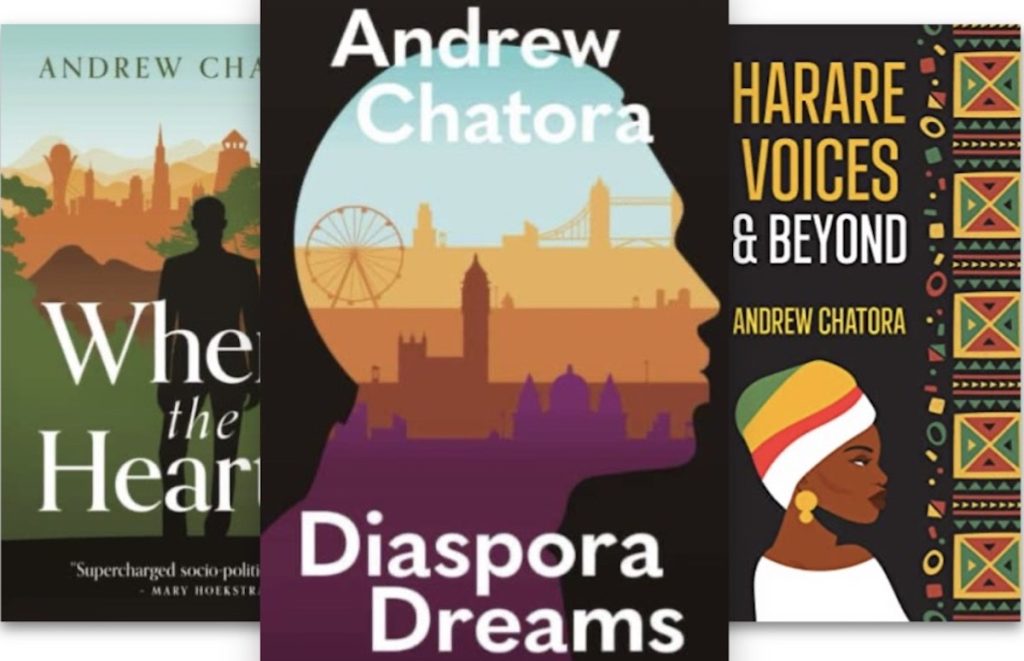
If the Diaspora Dreams author is not championing immigrants in his adopted country, he is probably the only writer crossing floors to taking a second look at race relations back in his country of birth. His award winning 2024 novel Harare Voices and Beyond is unusually written from the viewpoint of former white farmers. This is the first contradiction. What we call representing the people naturally forms a mental picture of a rally, a march, a truth grounded numbers. But what does representing the people mean when dealing in the human business does not always translate to dealing in the popular opinions of history. Unstoppable March of the Human Condition earns its name; it is not the unstoppable march of the popular condition.
The second contradiction concerns my opening observation. For a writer who outfaces for disenfranchised majorities and precarious minorities in three novels and a short fiction collection, Chatora’s essay collection is really writing thinking itself. “Turning to non-fiction as a break, allows writers to reclaim their own narratives from outsider perspectives and to document complex, fast-changing realities, and address urgent socio-political issues,” literary critic Memory Chirere writes in the book’s preface. I identify with Unstoppable March of the Human Condition’s painstaking investment in the image of the writer. You can touch my language, touch my tribe, touch my totem; nobody is touching my writerly snobbery.


The one thing Derrida half-heartedly deconstructed – from refusing camera interviews to putting the camera on set – was the image of the writer. In the global changes of the day, that’s the image I am not exchanging for the world. The writer is a visible play-actor in the truth games that make the world. On the contrary, the power behind AI and other global changes has made the writer shit unto himself to invent the truth with unseen hands. The new philosophers of Munhumutapa are conjuring a whole field of Afrocentric operators to play these magic games.
Crucially, Chatora is also reassessing his influences and, I daresay, setting the stage for his new sequence. The book explores race, identity, migration, literature, politics and belonging. “At its heart, the collection asks how literature helps us understand dignity, displacement and the human consequences of history within a rapidly changing postcolonial world,” reads the Publisher’s editorial statement.
Chatora writes with one foot at home and another foot in the Diaspora, driven to the watchpost by the cynical conspiracies multiplied by the system against the bottom of the pyramid. Consider a Zimbabwean compatriot, make him a comrade in urban survival, chased out of South Africa, only to come home to a demolished neighborhood, demolished industrial sheds, and you have the kind of demographic that keeps Chatora awake at night. With this new offering, Chatora maintains his socially urgent approach.
Produced around a for-us-by-us ethic, the book is the maiden publication of Chatora’s recently launched Friesian Publishing. Having published his previous books with an American imprint, Chatora has moved to assume – or forestall? – control of his creative legacy. Given his notoriety for broaching touchy terrains such as gender and the tenuous condition of the immigrant, regardless of where she might be coming from, Chatora has seemingly acquired his new publisher hat to stay outside the evolving demands of political correctness.
The choice of an essay collection as the founding statement of the new publishing house sounds necessary for a writer who has so much to say, culturally and politically, and as much risk to be misunderstood. Let’s peek into some of the arguments of Unstoppable March of the Human Condition.
His first message is a non-political one. He argues at the risk of overemphasis that he, and any writer worth the salt, primarily writes for the fun, leisure, and self-contained meaning of it. To write is, in itself, a cause that needs no further qualification. For colleagues like Chatora, writing may be purist rather than instrumentalist. The essays, “The Burden of the Writer’s Legacy” and ‘‘Who Needs a Writer?’’ “There Is More to Writing than Dollars and Cents” hit home without much sophistry. They are a plea for the place of the writer in a world that measures everything by a corresponding bank balance. The pure pleasure of writing is how one would need to discriminate between computer-generated writing or commercially driven writing against the fine art of a soul speaking beyond age and time because it must. As the prophet Jeremiah puts it, if the writer does not deliver his message, it is a fire shut in his bones. Dambudzo Marechera’s paramour, Flora Veit-Wild, puts it more succinctly: Write or go mad! This is the curse, rather than the calculation, that made our comrade a writer. And he goes to town in these essays defending the pure necessity of his office.
Chatora’s namesake, Andrew Keene earned the singular moniker, the Antichrist of Silicon Valley, for a series of intensely argued books decrying the internet as the cult of the amateur. One imagines in hindsight tech execs chuckling over their tea: “There speaks a man who has not seen AI.” If the web 2.0 cult of the amateur conspired to make everyone an expert, then the web 3.0 era of generative AI wants none to be one. No writer, no professor, no musician, no photographer, no painter, no expert of anything, just AI, just some giant know-it-all morphing into a do-it-all. The writer in this new common era rightfully feels cornered into a trial for his time. The challenge posed by AI to the writerly office is one of the discussions taken up by Chatora, in Unstoppable March of the Human Condition, itself a title with the sort of existential ring one would have invoked in lockdown or some such threat to the human spirit. But Chatora has come for more.
Chatora doesn’t shy away from this sort of elephant in the room. In an essay on the place of A.I tools in professional writing, Chatora conjures up a poetaster type whom he names Nwako, an Everyman stand-in for the large-language-model era cult of the amateur. This character, a fellow employee, eternally taunts Chatora over his new-found ability to churn out a book in-between meal and dessert. It’s serious work to live your life as an artist, burning away to shine your truth in the world, only for a happier mortal to line up your go-to source of publishing news about yet another latest book he has just written, or rather, prompted in two minutes. That’s Nwako, one of the anecdotal characters in the collection.
It’s an interesting piece because the novelist gives character to his colorful pretender to literary prestige. Chatora’s initial reaction to Nwako is wholesale dismissal. But those who know Chatora the novelist know that there is a mean kicker at the tail end of a long read. In this case, it turns out that he was experimentally writing this very essay with AI. The pragmatic position taken between Nwako’s Philistine extreme and the author’s initial Luddite attitude is approaching AI as a tool rather than an oracle or replacement of the writer.
A little further into the book, things get a little more political. In “Poking the Bear”, the writer is not in doubt at all as to the social role of the writer, invoking a long line of contrarian torchbearers including Ngugi wa Thiongo and Dambudzo Marechera, down to contemporary protest artists. Chatora flexes his pop sensibility in much of the book, a credit to his cosmopolitan positioning. Folk sing-songwriters get a branch in his prophetic family tree. Kendrick Lamar has a look-in.
Chatora also discusses the role of the immigrant writer whom he calls the Nowhere Man. Perhaps this nowhereness bears stressing in the context of Chatora’s new publishing house. How do you take up the cause of a disempowered figure marked for placelessness by a xenophobic vote and institutional functions when your literary midwives are nothing less than the soft power engines of the same system. We may never outgrows the need for an global south-oriented publishing infrastructure and Chatora is putting plans to action with Friesian Publishing.
“On the whole, Chatora is wrestling with the role of the writer in a world that’s no longer sure it needs him”.
Talking of decolonizing the publishing infrastructure, Chatora wades into Ngugi wa Thiongo’s famous language debate, especially since the don’s war against English remains fashionable. Chatora does not consider ready-made cosmopolitan vehicles anathema to the extent that he can work within his own agency. His position is close to Achebe’s claim of making English obey his Igbo, and Ayi Kwei Armah’s dismissal of Ngugi as speeding in rear-view when what is needed is a common African language. It is partly his weaving in of the old masters’ beefs that makes Chatora’s book an enjoyable read.
On the whole, Chatora is wrestling with the role of the writer in a world that’s no longer sure it needs him. Regardless of his conclusions, Unstoppable March of the Human Condition is a speech act with the kind of energy I vibe with. Old-fashioned conceits like W.B Yeats’ Rhymers Club, French Film’s Tradition of Quality and the Frankfurt School’s High Culture, all this revenge of the snob: count me in!
Unstoppable March of the Human Condition is available on Amazon, online book retailers. In Zimbabwe, it is distributed via Book Fantasticks in Harare contactable on: +263 77 921 0403 and Bhuku Store based in Borrowdale also contactable on: +263 77 930 3621.
Onai Mushava is an award-winning Zimbabwean writer and cultural journalist. He can be reached at mukomaonai@duck.com
Follow This Is Africa on Twitter and Facebook to join the conversation.