
Business
America’s tariff wars present no upside opportunities for African economies
The tariff’s most important negative impact will be via the coming global economic slowdown.


I: Putting on a brave face amidst impending economic chaos
Amid the turmoil in global markets caused by America’s protectionist turn, there have been attempts across Africa to put a positive spin to the chaos. For instance, Kenya’s Ministry of Trade & Industry issued a statement arguing that it remains a competitive frontier market destination for FDI because it only got hit with a 10% tariff. Others noted that African countries’ low trade volumes to the U.S. mean that they’ll be shielded from the worst effects of the tariffs. Yet others have argued that this is an opportunity for African states to make bilateral trade deals with the United States.
 |
Trends in the World Uncertainty Index. Source: UNCTAD
To be blunt, most of this is wishful thinking. The fact of the matter is that, since African countries face greater *perceived* uncertainty during global shocks, there is very little potential upside for African countries in the unfolding chaos. The coming global economic slowdown will most likely reduce demand for Africa’s (mostly) commodity exports; and shrink the supply of the relatively meager foreign direct investment (FDI) the region currently receives. Trade with the U.S. will not magically pick up on the back of whatever deals African capitals arrive at with Washington.
At the moment no one is itching to relocate their factories and related supply chains from East/Southeast Asia to Africa. And even if they were to do so that process would take years. Plus it’s not like African countries are competitive on their most important advantage: abundant labor. African labor remains more expensive relative to most of Asia. That’s before we even get to the region’s logistics and infrastructure gaps (power, roads, ports) and policies that are hostile to trade.
 |
African exports as a % of world trade, 1960-2020. Source: How Africa Trades(edited by David Luke, 2023)
The only potential silver lining in the coming chaos, at least in a select group of countries, is that the global discourse on trade might wake up policymakers from their decades-long stupor. Despite the commodity-fueled ten-year rally in the early 2000s, Africa’s share of global trade (both goods and services) remains far below its peak in the mid 1960s (countries like Benin, Lesotho, and Morocco that are serious about export growth are the rare exceptions).
Notice that the rise in exports in the early 2000s was largely driven by ballooning fuel exports from a few countries. Agricultural products and manufactures still lag fuel exports. Not even ores and metals did as well as one would expect from reading the news on Africa’s unlimited mineral resources (Africa’s share of global mineral output is remains below 6% — and it’s not just because of transfer pricing by foreign mining firms). Meanwhile, manufactures continue to comprise the lion’s share of the region’s imports.
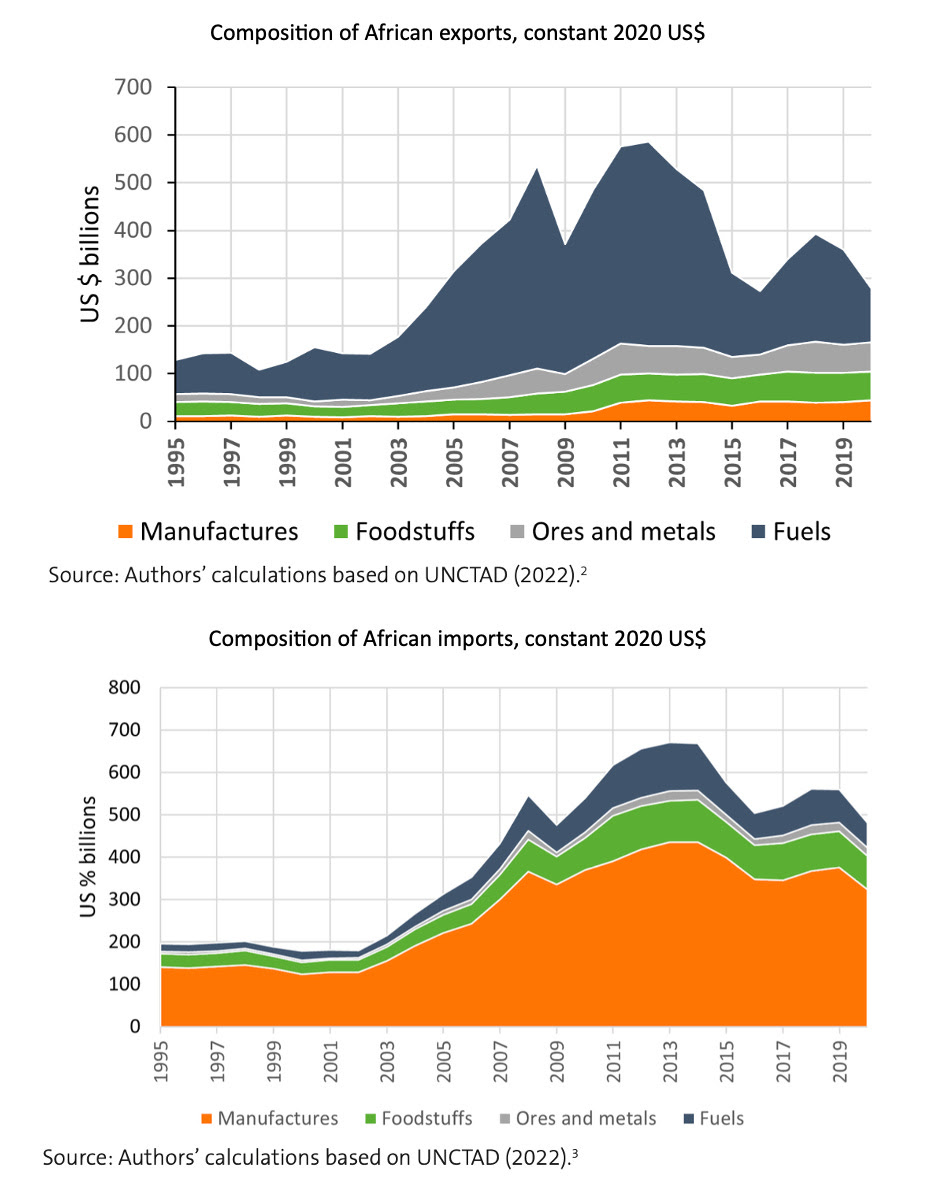 |
Trends in African exports and imports. Source: How Africa Trades (2023)
All this to say that African policymakers must remain grounded in their reactions to the coming tariff wars, and subsequent shifts in patterns of global trade. They must not pretend that things were fine before the current shock and avoid being sidetracked by time-inconsistent deals (At the moment the U.S. government is nothing but a haven of policy instability). To this end, South Africa and Kenya (among others) should abandon their quests for bilateral deals with the United States and assume leadership on these efforts. The region’s more serious countries should also double down on deepening intra-Africa trade through the Africa Continental Free Trade Agreement (AfCFTA). Moving more goods and services within the Continent can serve as a training ground for export-led growth strategies, in addition to helping build supply chains that are robust to future global shocks.
At the country level, policymakers need to cut through the empty slogans about jobs and demographic dividends and have an honest conversation about the political economy of export promotion. The simple truth is that it’s far much easier to collect rents and/or tax commodity exports and imports of consumer goods than to take the risk of nurturing a domestic manufacturing or value addition base. All the former requires are customs officials and brokers (and in some cases minimal investments in localized assembly/packaging). The latter requires strategic long-term ambition and consistently serious attention to policy across multiple sectors.
II: Deeper intra-Africa trade should provide the foundation for greater global openness
Instead of rushing to Washington to cut lopsided bilateral deals or imbibing copium about Africa’s alleged advantages over Asian countries facing higher tariffs, African governments should (1) not retaliate and (2) exploit the increased salience of trade policies to strengthen intra-Africa trade and rethink Africa’s positioning (or lack thereof) in global supply chains.
The primary goal of these efforts should be to consolidate and extend the gains in trade volumes made over the last 25 years — by embracing the principle of smart openness to trade (especially with other African countries). For the most part, protectionism by default defines the trade policies of most African countries. Much of the protectionism results from sheer inertia, policy capture, or zombie ideological tics not founded on any sound thinking. It is not a surprise that there isn’t a single African Fortune Global 500 company.
This has to change. Trade policy should be calibrated in service to specific developmentalist ends — principally to promote globally-competitive African firms. There certainly will be justifiable reasons to pursue targeted protectionism. However, every protectionist policy ought to be judged by its contribution to specific developmentalist ends. In the same vein, everyone on the Continent should wake up to the idea that reflexively protectionist policymakers rarely succeed at promoting exports. This is precisely because such individuals usually don’t understand how trade works in either direction.
 |
Relative importance of Africa as a trade partner — Africa’s share of total trade by country/region. Source: How Africa Trades (2023)
As part of the push for more trade, charity must begin at home. Intra-Africa trade comprises the bi