
Politics and Society
Zambia at a crossroads: Preserving democracy beyond the ballot
Zambia’s peaceful polling day has given way to a far more precarious test: a nationwide suspension of vote counting, competing victory claims and allegations of electoral interference. The emerging crisis exposes the danger of an information vacuum—and whether Zambia’s institutions can prevent electoral uncertainty from becoming political confrontation.

Published
2 months agoon
I warned on the eve of polling day that Zambia’s 2026 election was likely to face disputes once the votes were counted. The issue was never simply whether Zambians would vote peacefully, but whether political actors and electoral institutions would manage the inevitable contest over the results without allowing disagreement to become confrontation.
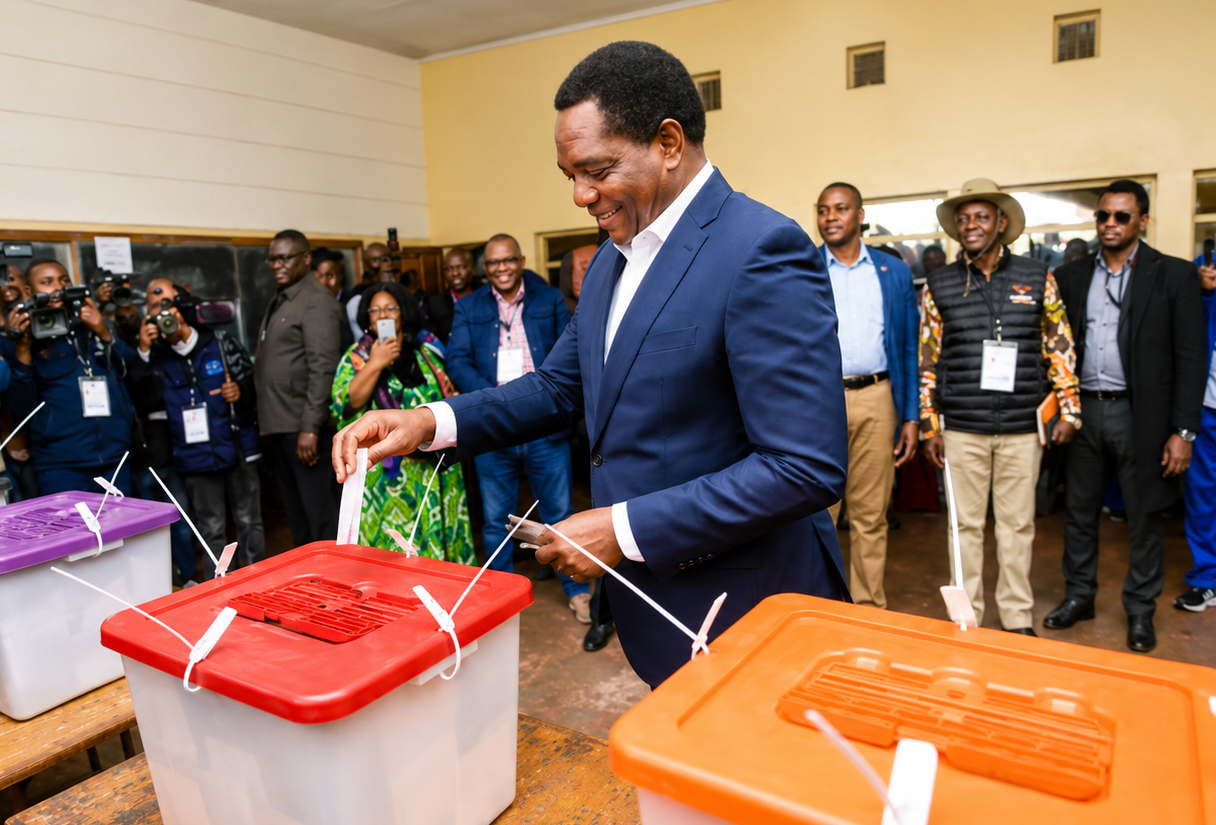
For much of 13 August, the country appeared to pass that test. I spent time moving around Lusaka, observing the voting process and speaking to citizens at different polling stations. What stood out was the patience of ordinary voters. People queued, voted and went home. There was a palpable sense that the ballot offered a peaceful way of settling political differences.
But that calm is now being tested.
Early figures circulating from polling stations appeared to give incumbent President Hakainde Hichilema strong momentum, suggesting that he could be on course for victory. This outcome aligns closely with the structural analysis we outlined in our pre-election PARI-Africa briefing. We postulated that Hichilema maintained a distinct electoral edge, driven by a severely fragmented opposition field, incumbent organisational advantages and recent electoral delimitation reforms that expanded constituencies in key bases. While cost-of-living concerns created friction, the lack of a unified opposition candidate meant Hichilema was consistently positioned as the likely victor.
Opposition presidential candidate Brian Mundubile, however, released a seven-minute video claiming victory based on his party’s Parallel Voter Tabulation (PVT). His claim was subsequently reported by several media outlets.
Such unilateral declarations, outside the official declaration process, risk creating confusion and unnecessarily raising political temperatures. Zambia’s electoral laws provide mechanisms for dealing with disputed electoral conduct, and those mechanisms should be allowed to work. The Electoral Process Act No. 35 of 2016 establishes the legal framework governing the conduct, counting and announcement of election results.
The more serious concern is what is happening around the counting and verification process.
The Electoral Commission of Zambia (ECZ) has suspended the counting and announcement of results nationwide. In a statement signed by ECZ Chairperson Mwangala Zaloumis (SC), the Commission cited reports of violence against polling staff in some districts and the theft of marked ballot papers from ballot boxes. It said the suspension would be reviewed within 24 hours. The suspension has also been independently reported by Reuters and the Associated Press.
These developments closely reflect the structural analysis outlined in our pre-election PARI-Africa briefing. Our analysis anticipated that while voting day itself would be orderly, the collation phase would be the primary flashpoint because of institutional fragility and deep-seated political mistrust. We also highlighted how procedural delays by the ECZ could create an information vacuum, leaving the process vulnerable to social-media claims and competing tallies—a dynamic now playing out following Mundubile’s online announcement.
The ECZ is right to take threats against its staff and the security of electoral materials seriously. Yet the blanket suspension also carries its own danger.
Reports and allegations are now emerging from places including Mufulira, Chawama and Matero, as well as parts of North-Western and Northern provinces, involving alleged interference with ballot boxes, Gen 20 forms and the movement of electoral materials. These allegations were raised by Mundubile in his statement and should not be treated as established facts without independent verification. They do, however, require prompt and transparent investigation.
This is precisely where the ECZ’s communication becomes critical.
In my assessment, the Commission had, until this point, done a commendable job in managing a complicated national election. But it now risks tarnishing some of the credibility it has built if the public is left without regular and credible information about what is happening.
Information vacuums rarely remain empty. They are quickly filled by rumours, misinformation, competing party tallies and claims of electoral manipulation.
That is already becoming evident.
Having spoken to people in Lusaka during and after polling day, I was struck by how little ordinary citizens are asking for. They are not necessarily demanding that the ECZ announce a winner immediately. They simply want to know what is happening. They want to know whether their votes have been counted, where the results are coming from and why the process has stopped.
As we noted in our recent PARI-Africa briefing, the success of this election hinged not just on voting-day logistics, but on the ECZ’s capacity to maintain institutional resilience and transparent communication during high-pressure tallying. The current information vacuum illustrates precisely those structural risks.
The ECZ should therefore release verified results progressively as they come in. Where particular results cannot be released because of security concerns, discrepancies or the need for further verification, the Commission should explain this clearly.
Transparency and electoral integrity should not be presented as competing objectives. Transparency is part of protecting electoral integrity.
Political leaders also have a responsibility.
President Hakainde Hichilema has so far adopted a measured tone, describing the early figures as encouraging while urging Zambians to remain calm, patient and peaceful. His call for restraint is welcome.
But it must be matched by all political parties and their supporters.
Political leaders must stop inflammatory rhetoric and avoid language that can incite their supporters. They have a responsibility to lower political temperatures, not raise them. A disputed election must be contested through evidence, electoral procedures and the courts—not through threats, mobilisation or violence.
This is particularly important given the inflammatory rhetoric witnessed before polling day, including statements attributed to Binwell Mpundu, a senior figure in Mundubile’s political camp. Reports circulated of a Facebook video in which Mpundu made remarks interpreted as threatening violence. Because this concerns a politically sensitive allegation, the original material and its context should be independently verified before drawing definitive conclusions.
Such rhetoric, however, has no place in a democratic contest.
The warning signs from elsewhere in the region should not be ignored. Recent experiences in Tanzania and Mozambique illustrate the risks that can arise when electoral disputes, political mistrust and inflammatory rhetoric combine. Zambia should not assume that its reputation for peaceful political transitions makes it immune to such pressures.
Zambia must not go down that road.
I therefore believe the ECZ should urgently reconsider the blanket suspension of results. Where results have been verified, they should be released progressively. Where there are genuine disputes, those disputes should be identified and investigated transparently. Every ballot box and electoral record must be accounted for, and political party agents must be allowed to perform their lawful functions.
The solution to uncertainty is not more uncertainty.
Zambians have voted. They deserve to know what they voted for. The ECZ must provide credible and timely information; political leaders must exercise restraint; and every legitimate dispute must be resolved through lawful and peaceful means.
The election was peaceful at the polling stations. The challenge now is to keep it peaceful after the votes have been cast.
That is the responsibility of the ECZ, political parties, security institutions, the media—and ultimately all of us.
The credibility of Zambia’s democracy, and the peace of the nation, depend on it.
About the author:
Dr. Blessing Vava is a Zimbabwean scholar, researcher, and political commentator specialising in the intersection of technology, power, politics, and society across Africa. During his recent research placement in Lusaka, Zambia, during the pre-election period, together with Dr Tamuka Chirimambowa, he co-authored a strategic PARI-Africa analysis examining the key electoral challenges, governance trends, and democratic trajectory leading into the 2026 Zambian general election. He can be contacted on blessingvava@gmail.com
Follow This Is Africa on Twitter and Facebook to join the conversation.
You may like


The passport, the database and the State: Who controls digital Zimbabwe?


Zambia 2026: Beyond the ballot did SADC duck the election crisis? (SAPES Dialogue forum presentation)


Democracy in code: How digital power is reshaping sovereignty in Africa


The third global wave of autocratization One playbook, two instruments: Legal façades and structural decay in the world, with Indonesia and Kenya as case studies


Zambia’s opposition did not lose this election on the campaign trail. It lost it at the nomination desk


A mirror across the Zambezi: Why Zambia’s August 13 vote matters to Zimbabwe and SADC