
Opinion
Zambia 2026: Beyond the ballot did SADC duck the election crisis? (SAPES Dialogue forum presentation)
Zambia’s 2026 election delivered Hakainde Hichilema a decisive victory, but exposed troubling weaknesses in electoral transparency and institutional trust. Dr Blessing Vava argues that the deeper test now lies with SADC: whether regional election observation can evolve from documenting democratic shortcomings to ensuring they are actually corrected.

Published
2 months agoon
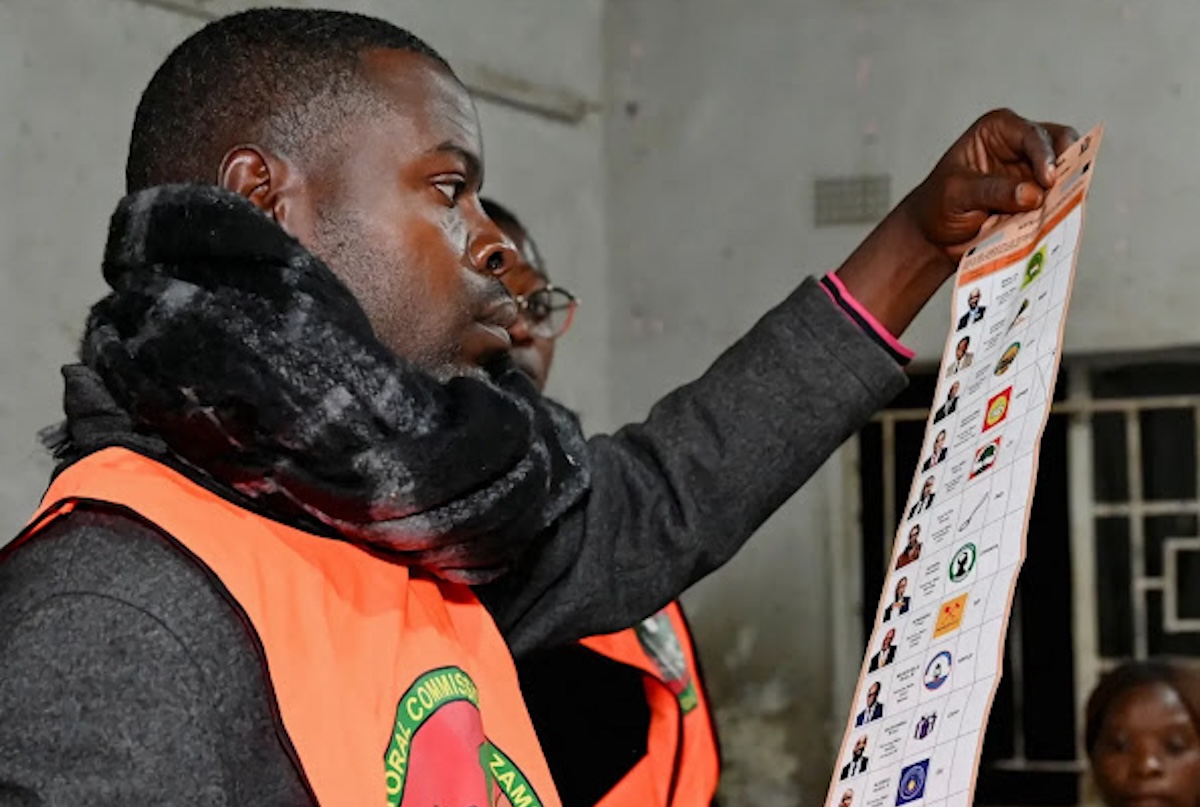
Presented virtually on 3 September 2026
I want to reframe it. The more important issue is not simply whether SADC “ducks” disputed elections. It is whether SADC has built an institutional system in which its own democratic standards can produce consequences, learning and correction once weaknesses are identified — and that distinction is where the debate about Zambia, and about SADC, should actually begin.
Zambia’s 13 August 2026 election produced a decisive presidential result. Hakainde Hichilema was declared the winner with 2,965,326 votes, against Brian Mundubile’s 1,856,217, giving Hichilema a margin of more than one million votes. The ruling UPND also secured 124 of the 226 constituency-based parliamentary seats.
On the evidence available, there is insufficient basis to declare that the presidential election was stolen, or that the result was produced through systemic, outcome-changing manipulation. But that should not end the discussion, nor should the size of Hichilema’s victory be used to dismiss the institutional weaknesses the process exposed. Both propositions can coexist: an election can produce a legitimate political outcome while still being an imperfect process that requires serious reform.
The danger of the false binary
African election debates are too often trapped in a binary — either the vote was completely free, fair and flawless, or it was stolen. That framing is analytically unhelpful. Electoral credibility is multidimensional: it concerns not only who ultimately wins, but whether citizens, candidates, observers and parties can understand and independently verify the process through which the result was produced.
Accepting a result does not require accepting every part of the process that produced it. Once we drop the assumption that every weakness must automatically prove fraud, we can finally examine those weaknesses on their own merits — a far more serious democratic conversation than the one Zambia has been having.
Can the result be independently reconstructed from the polling station to the national tally, and can citizens have confidence in the institutions responsible for that process? That is a far more useful question than simply asking whether the election was “rigged.”
The numbers are striking — but numbers need context
One of the most contentious post-election issues was turnout. National turnout was approximately 57.2 percent, down from 70.6 percent in 2021, and some constituencies recorded very high turnout alongside overwhelming UPND majorities. That scrutiny is justified — but unusual numbers are not automatically fraudulent numbers. The appropriate response to an electoral anomaly is verification, not immediately converting an anomaly into proof.
This matters particularly in Southern, Western and North-Western provinces, where UPND’s dominance did not suddenly emerge in 2026. It has deep historical roots: Hichilema and the party have recorded exceptionally high support in several of these constituencies in previous elections too. That history doesn’t prove every 2026 result was accurate, and it doesn’t prove any result was manipulated — it simply means the evidence has to be examined, not assumed.
The real test is whether the numbers can be reconstructed from the bottom up. Can polling-station records be matched to the GEN-20 forms? Can those forms be reconciled with constituency-level aggregation, and the constituency figures with the national tally? That evidentiary chain is what matters. Investigate the anomaly. Do not convert it into proof before the evidence exists.
Where the election damaged institutional confidence
If the presidential result can be supported by the available evidence, where should criticism land? My answer is: institutional confidence.
The most consequential development was the temporary suspension of counting and results announcement on 14 August. The Electoral Commission of Zambia (ECZ) cited security concerns, including violence against electoral personnel and the theft of ballot papers — circumstances that cannot simply be dismissed. Protecting electoral officials, materials and the integrity of the count is essential. But a national interruption of the results process is an extraordinary event. It creates uncertainty, and uncertainty in an election quickly becomes political distrust.
The issue, then, goes beyond whether the suspension was justified. It is also about how such a decision is communicated, understood and independently assessed. Citizens and political actors needed clear answers: What was the legal basis? What geographical area and what, precisely, was suspended? What security measures were introduced, and when — and under what conditions — would counting resume? How were parties and observers informed, and how were the affected ballots protected? The stronger the explanation, the less room there is for speculation. The weaker it is, the more space competing narratives have to fill.
SADC itself flagged the uncertainty and anxiety the suspension generated, while also recording positive aspects of the process — ECZ preparedness, the verification and custody of materials, functioning conflict-management mechanisms. That distinction matters: criticising how a process was managed is not the same as declaring its outcome fraudulent.
The politics of premature declarations
This brings us to another consequential episode: Brian Mundubile’s premature declaration of victory while the official count was still underway, despite the ECZ having already warned political actors against exactly this.
Precision matters here too. We should not claim that Mundubile’s declaration caused the violence and insecurity that followed — the evidence does not establish that causal link. What can reasonably be said is that premature declarations harden political narratives before verification is complete. Once a candidate tells supporters they have won, every subsequent official figure gets read through the lens of that claim. That is dangerous in any election, and especially dangerous where confidence in electoral institutions is already fragile.
The same standard should apply to every political actor: let the evidence catch up with the politics.
Fake GEN-20 forms and the new information war
The controversy over allegedly fake GEN-20 forms illustrates a newer dimension of election disputes. They are no longer fought only at polling stations, tallying centres and in courtrooms — they are fought on Facebook, WhatsApp, X and TikTok, where a photograph of an “authentic” results form can reach thousands within minutes, and a fabricated document can acquire the appearance of legitimacy simply through repetition.
Claims of fake forms should be neither casually dismissed nor automatically accepted — they should be authenticated. Is the document genuine? Does it correspond to an actual polling station? Can it be traced through the official results chain? This is precisely why publishing official electoral documents in accessible, machine-readable formats matters: if citizens, parties, journalists and observers can access the original forms, compare them against their own copies and independently reconstruct the aggregation process, fabricated documents become far easier to expose. In the digital age, transparency is itself a form of misinformation control. The same principle applies to claims that Zambia experienced an internet shutdown, throttling or other restrictions during the election.
These allegations are serious, because access to information is central to democratic participation — but they require technical evidence: network measurements, independent monitoring, platform and telecommunications data, not political assertion alone. The temptation in a contested election is to accept whatever confirms one’s existing position and reject whatever challenges it. That is precisely what serious election analysis has to resist. A credible assessment applies the same evidentiary standard to government claims, opposition claims and claims circulating online alike.
Neither documented institutional problems nor unverified allegations should be treated as automatically true.
So, what did SADC actually say?
This is where the debate needs more precision. SADC deployed 106 personnel from ten member states, organised into 17 Short-Term Observer Teams covering all ten provinces. The mission observed 277 polling stations out of the 13,529 established for the election. Its preliminary assessment did not describe the election as uniformly fraudulent, nor did it present it as flawless.
The mission found the political environment in most areas peaceful — many stakeholders considered it an improvement on 2021 — and noted positive practices around ECZ preparedness, the verification and custody of materials, and conflict-management mechanisms. At 275 of the 277 stations observed, the atmosphere was calm. At the same time, SADC flagged real concerns: the absence of dedicated legislation governing political parties, the timing and communication of electoral reforms, aspects of the new Mixed Member Proportional Representation system, media freedom, the inclusion of women and persons with disabilities, electoral violence, ballot secrecy — and, in particular, the uncertainty created by the 14 August suspension.
This matters: SADC’s preliminary statement was an observation assessment, not a judicial determination of the presidential result. SADC’s own mandate covered the pre-election, election-day and immediate post-election phases — not adjudication of them, with a fuller final report still to follow. That distinction has to be maintained if this debate is going to go anywhere useful.
Did SADC fail Zambia?
The answer depends on what we expect SADC to do. If the expectation is that SADC should overturn a result whenever an election contains significant weaknesses, the answer is no — that is not the role of an observation mission. SADC is not an electoral court, and it cannot replace Zambia’s courts or its Electoral Commission.
But if the expectation is that regional democratic standards should generate institutional learning and correction, a much harder question emerges: what happens after the observers leave?
That is the deeper SADC problem. The bloc has democratic principles and guidelines, it deploys observation missions, and it has the Electoral Advisory Council and its political and security structures. What is far less visible is the accountability chain linking one election to the next. If a mission identifies recurring weaknesses, who follows up? Who checks whether recommendations were implemented, who reports publicly on progress, and what happens when the same weaknesses reappear next time? If the answer is simply that another mission arrives a few weeks before the next poll and produces another report, regional election observation risks becoming ritual. Its value cannot lie only in documenting what went wrong — it has to lie in helping prevent the same problems recurring.
From election-day observation to electoral-cycle accountability
I would propose that SADC’s role evolve around three functions: observe, verify, follow through.
Observation means documenting the process impartially. Verification means helping create the conditions under which disputed claims can actually be tested. Follow-through means tracking recommendations between elections — and this third function matters most in the digital age, where electoral misinformation can travel faster than institutions can respond. Fabricated forms, manipulated videos, synthetic audio and misleading screenshots can shape public opinion before authorities have even established whether the underlying claim is genuine.
SADC does not need to become an electoral court to become more consequential. It can remain fully within its mandate while making the implementation of its own recommendations far more systematic.
What SADC should do differently
Every SADC Electoral Observation Mission report should generate a public implementation matrix: what was recommended, who is responsible, what the deadline is, what has been implemented, and what remains outstanding.
The Electoral Advisory Council should be used far more systematically between elections, not only around them. Regional attention should focus on the practical institutional weaknesses that recur across member states — results transparency, party regulation, media access, electoral security, dispute resolution and inclusion. And where recommendations go unimplemented, or the same weaknesses recur across elections, the appropriate SADC structures should initiate dialogue with the member state concerned.
Together, these changes would transform SADC from an election-day observer into an electoral-cycle institution.
Zambia cannot outsource its own reforms
There is another side to this argument: Zambia has responsibilities of its own that cannot be outsourced to SADC.
The ECZ should publish GEN-20 forms in machine-readable formats and provide a transparent mechanism for independently comparing polling-station, constituency and national totals. The rules governing any future suspension of counting need to be clearer — legal basis, geographical scope, duration, security arrangements and the procedure for resuming the count should all be communicated in advance, not improvised under pressure. Political-party regulation needs attention. Media and civic-space safeguards need attention. The accreditation system should be independently audited, particularly at the point where electronic systems hand off to paper-based processes. And after every general election, Zambia should conduct an independent technical and institutional review — not to determine which party won the argument, but to identify what needs fixing before the next one.
The opposition needs to look in the mirror too
It is tempting to load every electoral problem onto the ruling party or the Electoral Commission. That would also be a mistake.
The 2026 election exposed real organisational asymmetry: NRPUP contested 156 of the 226 constituency seats, while UPND contested all 226. That gap is not, by itself, evidence of an unfair election — but it illustrates the ch