
Politics and Society
Is South Africa Reverting to a Repressive State?
Since the Marikana massacre in 2012, several journalists, academics and media commentators have argued that South Africa is reverting to a repressive state. Could South Africa be turning into a repressive State?

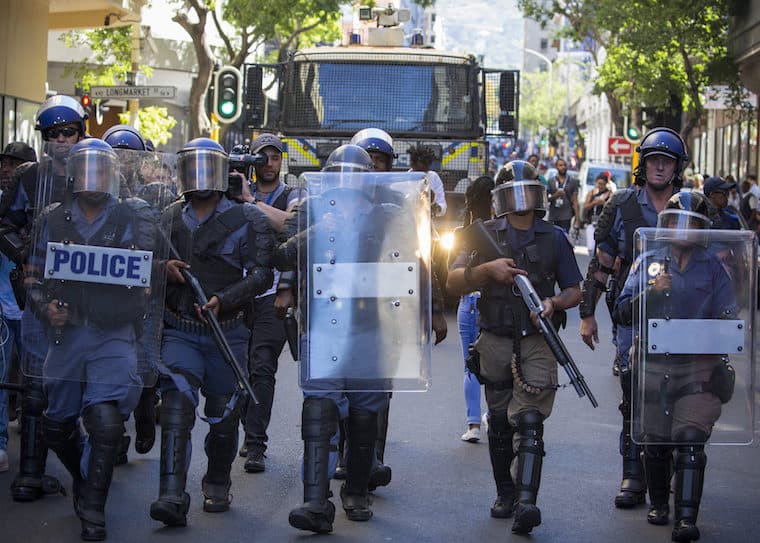
Since the Marikana massacre in 2012, several journalists, academics and media commentators have argued that South Africa is reverting to a repressive state. They have interpreted violence at the hands of the South African Police Service (SAPS) generally, and Marikana specifically, as signs that the post-apartheid social order can no longer be held in check through consent alone. They argue that the ruling African National Congress (ANC) and other powerful actors have concluded that naked violence is now needed to stabilise increasingly fractious social relations.1 Some have even used the term “police state” to describe post-Marikana South Africa.2 As a police state is one where the police act as a political force to contain social dissent using arbitrary force, it is an important manifestation of a more repressive state.
How likely is South Africa to descend into a state of full-blown repression? How likely is it that there will be more Marikanas? Need- less to say, being able to answer these questions will have a major impact on the future trajectory of the country’s politics. There can be little argument with the statement that South Africa’s democratic government under its fourth president, Jacob Zuma, has strengthened the coercive capacities of the state, consisting of the police, the intelligence and the military and located in the Justice, Crime Prevention and Security Cluster. In fact, it would appear that this Cluster has become the praetorian guards of an increasingly embattled presidency.3 The well-reported growth in the levels of police violence against ordinary civilians and protestors and police militarisation are the most visible manifestation of this shift, as is the normalisation of the military in domes- tic policing functions, which suggests a growing militarisation of society.4 However, the huge public controversies over police violence and police militarisation, mask the fact that there are fundamental shifts in the coercive capacities of the state, away from overt repression and towards less visible, more pre-emptive forms of repression. What are the indicators of this shift and why is it significant?

Members of the Association of Mineworkers and Construction Union (AMCU) dance and sing around Wonderkop Hill during the 4th anniversary of the Marikana shooting in Rustenburg, South Africa, 16 August 2016. Photo: ANP/EPA/Kim Ludbrook
From Human Intelligence to Signals Intelligence
The first indicator is that intelligence work has become increasingly important to stabilising social relations. Surveillance provides the state with a politically low-cost form of social control, as abuses are very difficult to detect. Political surveillance is part of an arsenal of tools available to the state to pro- file problem subjects, and to use this knowledge to stymie protests they may consider to be problematic. The state can use such surveillance, or the threat of surveillance, to create fear that organised violence will be used against perceived opponents.
At the same time, the fear of being watched may force people to self-police their own behaviour.
In South Africa, the state has expanded its surveillance capacities over the past decade. In 2003, the Thabo Mbeki Presidency issued a directive requiring an expansion of the-then National Intelligence Agency’s (NIA) mandate to include political and economic intelligence. In the case of political intelligence, the NIA was to focus on “…the strengths and the weaknesses of political formations, their constitutions and plans, political figures and their roles in governance, etc”.5 These changes led to the intelligence services ballooning in size. A year later, signs emerged that intelligence operatives were becoming embroiled in internal factional battles in the ANC: a problem that was proved to exist by a Commission of Enquiry, which partly blamed the culture of secrecy in the intelligence services as a source of the problem.6
Shortly after Zuma took office, the domestic and foreign intelligence services were centralised into the State Security Agency (SSA). The political intelligence- gathering mandate has also allowed the government to normalise spying on domestic political groupings on the most tenuous of grounds.7
A document leaked to the media, and apparently summarising the SSA’s National Intelligence Priorities for 2014 (which are classified, although they should not be) – and which are developed every year to guide the use of the state’s surveillance capacities – states that the SSA should investigate and engage in counter-planning for a “so-called “Arab Spring” uprising prior to [2014 national] elections’.8 The SSA claims it will resort to the “maximum use of covert human and technical means” to counter these threats.9 The document’s citing of the Arab spring – a legitimate struggle against authoritarianism – is significant, as it implies that this protest wave in the Arab region was essentially illegitimate. In the South African context, the risk of such a priority straying from the covert surveillance of illegal political activity into legitimate activities should be self-evident: a risk that is strengthened by the SSA’s overly broad mandate, excessive secrecy, recent history of abuse of this man- date and inadequate reforms to increase public accountability.

South African Police fire stand guard during a protest by students supporting the “Fees Must Fall movement” outside the South African Parliament where South African Minster of Finance delivers his Mid-term Budget address in Cape Town, on October 26, 2016. Photo: ANP/AFP / Schalk van Zuydam
The risk associated with human intelligence is that the identities of intelligence operatives deployed to spy on organisations can always be uncovered, leading to politically-costly scandals about intelligence abuses. As a result, the intelligence community has taken advantage of the digital “revolution” to shift away from using human intelligence (intelligence gathered through physical means) to signals intelligence (intelligence gathered from communications surveillance). It is difficult to tell whether South Africa has embraced this global shift, but it would be unsurprising if it has. While the government’s targeted interception capacities are regulated in terms of the Regulation of Interception of Communications and Provision of Communications related Information Act (Rica), mass surveillance remains completely unregulated in terms of the law, which pre- disposes these capacities to abuse. In fact, not only does South Africa produce mass surveillance technology, but the state has funded its development10 and allowed it to be exported, including to authoritarian regimes such as Libya, where the equipment was used to spy on Muammar Gaddafi’s political opponents.11
From Militarised Policing to Intelligence-led Policing
The second indicator, closely related to the first, is the shift from militarised policing to intelligence-led policing. As its name suggests, this policing model uses risk assessment as its main tool to direct policing decisions about where and how to intervene. The model is more recent than para- military policing, as it was conceptualised in Britain and the United States (US) in the 1990’s, but it really gained currency after the September 11 attacks on New York and Washington. Intelligence-led policing relies heavily on covert techniques for crime- detection, including paying informants, spying on individuals and organisations, the use of Closed Circuit Television (CCTV ) cameras, communications surveillance and the interception of voice and data traffic.12
Intelligence-led policing does not necessarily make human rights violations go away; it merely makes them less visible. This form of policing encourages problematic profiling of individuals or social groups that may resort to crime, which can lead to stereotyping of particular social groups as being predisposed to crime. Activists who are considered to be politically threatening to existing ruling groups may be placed under surveillance to gain more information about their activities and to intimidate them, which risks chilling political activity. The US police used intelligence-driven policing to infiltrate organisations linked to the anti-globalisation movement, to identify and isolate “troublemakers”.13 But like overt forms of violence, generalised surveillance techniques also erode public trust in the state: in fact, the latter can do so more readily than the former as surveillance proceeds from the premise that states do not trust their citizens from the outset.

Intelligence-led policing relies heavily on covert techniques for crime- detection, including paying informants, spying on individuals and organisations, the use of Closed Circuit Television (CCTV ) cameras Photo: Centralhighlandssecurity
In South Africa, the Crime Intelligence Division of SAPS holds the key to this new policing strategy, so it is unsurprising that this Division has become so powerful (and controversial) in recent years, as this policing model makes it the lynchpin of policing strategies.14 Heightened power without heightened accountability is a recipe for disaster. A case currently being heard in the Pretoria Commercial Crimes Court points to members in the division having used the surveillance capacities of the state to spy on journalists. Yet, in spite of its increasing importance to policing work, there are signs of Crime Intelligence having lost its effectiveness, leading to a resurgence of organised crime.15
SAPS has embraced intelligence-led policing for several reasons. Police violence is eroding trust between the police and communities, making it more difficult to revert back to community policing.16 Yet at the same time, SAPS cannot risk many more high profile shoot-outs with protestors, as the long-term political costs will simply be too great. So, it stands to reason that the SAPS would search for a policing model that still allowed them to contain dissent using a less politically-risky approach, and intelligence-led policing provides just such a model.
From Post-hoc to Preemptive Repression of Protests
The third indicator is an increasing use of pre-emptive methods of containing protests through manipulations of the Regulation of Gatherings Act (RGA), to stop more protests from spilling out onto the streets in the first place. In a research study I led on the right to protest in eleven municipalities17 – and which involved the physical collection and logging of municipal data about gatherings and protests over a five year period (2008-13) – I found that none of the municipalities studied received a clean bill of health. A research team collected all notifications for protests and gatherings sent to municipalities in terms of the RGA: they yielded incredibly rich data about how many protests were taking place relative to gatherings, the rea- sons for the protests, the protest actors and municipal responses to the protests.

Police officers arrest a Congolese protester after a protest against the Democratic Republic of the Congo President, Joseph Kabila outside the DRC’s Embassy on December 20, 2016 in Pretoria. Photo: ANP / AFP John Wessels
The municipal and the police statistics suggest that the majority of protests take place peacefully and uneventfully, which is not the dominant image of protests either in the media or the public imagination. In fact, from SAPS’s Incident Registration Information System (IRIS) database for the areas with the most unrest-related incidents between 2009 and 2012 18, it became clear that despite being labelled unrest-related, most of the protests did not escalate beyond barricade-building and tyre-burning, and in fact were recorded as being fairly incident-free.19 The protests recorded in the municipal records constitute a humdrum of protests, taking place day in, day out throughout the country with little incident. Between the media and police hype about “violent service delivery protests’, it is this wider picture of peaceful protests that is so often missed, and unsurprisingly so. The security cluster can use images of marauding mobs, apparently predisposed to violence, to create moral panics in the public about protests, to turn the public against protestors (even those whose demands are legitimate), and to justify heightened security measures against them.

Yet in spite of protests remaining largely peaceful, all the municipalities surveyed instituted unreasonable restrictions on the right to protest, and these have curtailed this right to varying degrees. While the misapplication of the RGA has been a problem at least since the early 2000’s20, a particularly significant shift became apparent from 2012 onwards. In the wake of the local government elections, the Department of Co- operative Governance sent out a circular to local governments that outlined proactive measures that municipalities need to take to deal with protests. These measures included “… [working] with the office of the speaker [and] public participation units to ensure ongoing engagement between councillors and communities and residents’.21 Several municipalities used this memo as a pretext to change how they administered the RGA.
This shift increased the already-onerous bureaucratic obstacles municipalities put on protests, many of which already shared an assumption that the notification process in terms of the RGA was actually a permission-seeking exercise, and that they had the right to grant or deny “permission” to convenors to engage in a gathering or protest. This municipal misapprehension of the pro- cess set the tone for how notifications were dealt with, both by the municipalities and by the police. Practices that limited the right unduly included a requirement on the part of convenors to seek a letter from the institution or person they were marching against, guaranteeing that they would be willing to accept the memorandum. The rationale for seeking such an assurance appears to be to prevent frustration on the part of protestors, which could boil over into violence. How- ever, it has also become a censorship device, where those who are being marched against can squash the protest simply by refusing to accept the memorandum.

A student wears a T-Shirt with the defaced image of president Jacob Zuma over his head during a student protest over fees to parliament on the occasion of South African Finance Minister Pravin Gordhan presenting his Medium Term Budget Policy speech to Parliament in Cape Town, South Africa, 26 October 2016. Police used stun grenades and rubber bullets to disperse student protestors demonstrating at the gates of parliament as the Finance Minister delivered his medium term budget policy speech. Photo: ANP/ EPA/NIC BOTHMA
The City of Johannesburg requires protest convenors to seek permission from a ward councillor to protest, and after the 2012 Co-operative Governance memo, they and the Mbombela municipality, instituted a filtering system to reduce the number of service delivery protests, where convenors need to show that a meeting took place between the mayor’s office, the community and the ward councillor involved in that community, or at the very least that an attempt was made to bring all parties to the table to resolve the issues at hand.22 But this prescription is not lawful, as the RGA does not prescribe what process people should follow before they take to the streets.
While the municipalities studied have gradually closed spaces for the right to protest, this closure is highly uneven and subject to considerable contestation. Spaces were much more closed where the political and economic elite were united in their intentions to stifle protests.
The number of “approved” protests increased in Mbombela once the filtering process was introduced, suggesting that the potentially “troublesome” protests did not even enter into the system. But the municipality did admit that the condition had led to an increase in the number of “unrest-related” protests, taking place outside the framework of the RGA, and that the police were more likely to be heavy-handed against such a protest. These were led mainly by individuals or organisations that were in dispute with the structures they were meant to negotiate with, suggesting that an increasingly restrictive approach towards protests on the part of the municipality was changing the character of the protests, forcing them to become what the authorities would consider “unlawful” and driving up the potential for the protests to become disruptive.
While the municipalities studied have gradually closed spaces for the right to protest, this closure is highly uneven and subject to considerable contestation. Spaces were much more closed where the political and economic elite were united in their intentions to stifle protests and prevent criticism and alternative forms of mobilisation: but this unity was not found uniformly across the municipalities. As Oliver has argued, erratic government repression arises not because the government has chosen to be erratic, but because of inconsistencies among political actors.23 Furthermore, non-conventional actors are more likely to be repressed than conventional ones (such as unions or well-known political parties), as the security apparatus consider the former to be less predictable than the latter.24

University of Johannesburg students raise their hands while blocking a motorway during clashes with riot police on September 28, 2016 outside the University of Johannesburg Campus.
The issue of education fees ignited widespread frustration over a lack of opportunities for young South Africans, worsened by a weakening economy and high unemployment. Photo: ANP/AFP. Marco Longari
The evidence supports a view of the state put forward by Gramsci that it is not monolithic, but is rather a site where ruling class alliances take place or even shift.25 In times of significant political de-alignment, elements of the state can even work against one another. Erratic repression is likely to occur when divisions have opened up within the political elite, or between the political elite and the bureaucratic layer: in such circumstances, spaces for alternative voices remained open, albeit constrained and subject to reversal.
Internationally, the academic literature has recognised the fact that ruling elites
have expanded their repertories of social control beyond outright repression: as a result, the literature has shifted away from focussing on the concept of repression, to that of pacification. According to Kein- scherf, pacification includes measures that “…produce undisruptive and unthreatening forms of collective action”.26 However, this is not to say that repression as it is commonly understood, and pacification, are mutually exclusive: in fact, they can be complimentary strategies. For instance, the intelligence services can be used to separate out “good” protestors from “bad” protestors, and the resulting protest policing may be either facilitative or militarised depending on the type of risk management strategies that the police identify through the intelligence gleaned.27 But the fact that the elites have found it necessary to shift from more visible to less visible forms of social containment at all, is not a sign of their strength; rather it is a sign of their weakness as they recognise the fact that they lack the capacity to repress openly. Why is this so? The next section will attempt to answer this question.
Organic Crisis: Growing Popular Capacity for Independent Action
It seems fair to say that South Africa is manifesting more elements of a classic Gramscian organic crisis. For Gramsci, crises become organic when they are thrown up directly by contradictions in how the capitalist system functions, when they are dynamic in that they are not confined to particular actors, events, issues, or moments in time or place, and consequently when they are a process rather than a momentary eruption. The demands being raised may be diverse, and at times even incompatible. Such crises usually arise when a particular regime of capitalist accumulation becomes unsustainable because of its own internal contradictions. In such circumstances, the ruling bloc (or the coalition of interests that underpin a particular ruling group) loses its legitimacy on a mass scale. An organic crisis develops when the following conditions obtain:
Popular capacity for action increases;
More people can be detached from the previous hegemonic block and be convinced to side with the subaltern classes;
There is a decline in capacity of the elite to offer significant concessions, but;
There is also a decline in the capacity of the hegemonic bloc to mobilise effective repression.
When these conditions obtain, the hegemonic bloc cannot offer concessions easily, yet neither can it repress easily either.28
With regard to popular capacity for action increasing, while the number of crowd management incidents increased year-on-year since 1996, too little can be deduced from this upward swing, as the police database that logs these incidents (the IRIS system) records both protests and gatherings. However, from the municipal data referred to earlier, it is apparent that protests peaked in 2011 (the year of the local government elections) in municipalities such as eThekwini, Johannesburg and Lukhanji, which is when crowd management incidents recorded by SAPS peaked too. So it is not unreasonable to assume that the peaking of incidents in 2011 can be attributed at least in part to an uptick in pro- test action, suggesting an increase in popular capacity for action as expressed through protests.
There was little evidence of co-ordination across protest sites, though; co-ordination occurred when a trade union movement organised a national action, or where a strike took place in different parts of the country, for instance a public sector strike. While there was little evidence of these protests coalescing into more generalised political demands, they have the potential to if a national political movement comes into being that links these different struggles together. The municipal data pointed to high levels of organisation, and of new formations or even organisations emerging all the time, suggesting that Patrick Bond’s term “popcorn protests”29 – used to describe seemingly sporadic, spontaneous protests ignored the extent of organisation that actually exists.
There was no evidence of unions and community organisations uniting around shared grievances. However, it was apparent from the municipal data that struggles at the point of consumption are becoming as important to the political life of direct action politics as struggles at the point of production, and in some cases (in the Makana municipality, for instance), the former are overtaking the latter as flash- points of struggle.
When South African protests are viewed in the global context, it becomes apparent that popular capacity for action is not only increasing, but these increases are being sustained. The protests could easily be described as a cycle in the sense used by Tarrow.30
However, is the protest cycle in South Africa of even greater historical significance? For instance, could it be part of a broader regional or even global protest wave? The question of whether the protests, including those in South Africa, are part of a wave, rather than being isolated, single- country protest cycles, is an important one, as it speaks to whether the protests will fizzle out in time or escalate into fundamental and transformative challenges to the system on a worldwide scale. According to Colin Beck, the difference between a protest cycle and a protest wave is that the latter is present in at least two or more societies within a decade of each other, and these protests are tantamount to revolutionary situations.31 In other words, the protests affect more parts of the world over a longer period, and are not concentrated in a fixed period in time or driven by a small, well-defined set of actors. These features suggest that the unfolding struggles are responses to broader crises in the world economy, and in spite of their heterogeneity, they are capable of being sustained and even escalated into an insurrection precipitating an organic crisis.

Scores of Zimbabweans headed calls to peacefully demonstrate against the worsening economic woes Photo: Arthur Chatora
The mobilisations in Chiapas, the Occupy movement in the United States, the “pink tide” in Latin America and “Arab spring”, Palestinian struggles against Israeli occupation, and anti-austerity protests in different parts of the world, are all examples of challenges to the system in different regions of the world (some more successful than others). Less well-known and studied are the wave of protests that engulfed sub- Saharan Africa in the wake of the Tunisian and Egyptian political revolutions, with the most pronounced ones erupting in Swaziland, Mozambique, Zimbabwe and Malawi.
For Cox, if protest cycles are sustained in more than one region of the world over a period of at least fifteen years, then this is a further indication that the crisis is organic, rather than episodic; as a result, the multiple resistances that have been mounted against the system could be described credibly as a revolutionary wave. Sustained regional disruptions usually happen at least once every twenty years. The fact that some have not led to regimes falling, and where political revolutions have been achieved, they have not necessarily deepened into social revolutions, becomes less significant if revolutionary waves are understood as a process rather than an event. If these protests have brought new political actors onto the streets, resulting in new forms of organisation, and extracted significant concessions from ruling elites, shaking the state in the process, then they could be described as moving in an anti-systemic direction. This is because the protests build confidence in the power of collective action, and consequently have the potential to extract even more significant concessions in future.32 When viewed in this global context, it becomes apparent that South Africa’s protests are of world- historical significance, and point towards them being part of a broader global wave of heightened popular action. They are also likely to place popular limits on the state’s ability to use organised violence, as doing so may well intensify popular action rather than dampen it.
In fact, while the protests cannot be said to have a distinct ideological character, the data points to the hegemony of the ANC diminishing.
With respect to more people detaching themselves from the hegemonic bloc, the municipal data before 2011 pointed to the ANC alliance dominating the protest space – especially in smaller towns and rural areas – but that its dominance declined after 2011. The ANC alliance has proved to be a combustible one, with political alignments with the ruling party coming under considerable pressure. At community levels, the municipal data suggested that the South African National Civic Organisation (Sanco) – often considered to be a fourth member of the ANC alliance – is largely a spent force, and is being overtaken by a host of independent community organisations or civics. In fact, while the protests cannot be said to have a distinct ideological character, the data points to the hegemony of the ANC diminishing. This does not support arguments advanced by Booysen and Fakir that the protests are merely about holding the ANC to account33: rather there is growing evidence of more communities becoming subjectively available for alternative politics to that offered by the ANC alliance.
Organic Crisis: Concessions or Repression
With respect to Gramsci’s two other conditions for an organic crisis, namely that the elite cannot offer concessions very easily, but neither can they repress very easily, the neo-liberal phase of capitalism has entered a period of organic crisis in several regions of the world. This phase is characterised by the financialisation of the economy, the rise of permanent mass unemployment and declining rates of profit, creating conditions for a political crisis. In other words, these features make this phase particularly unstable in that it creates conditions for mass revolt, as fewer concessions can be offered than in earlier expansionary periods (such as was the case under social democracy), while the system cannot generate enough profit to prevent itself from contracting and even collapsing, worsening the socio-economic conditions even more.
In the case of South Africa, while the Zuma administration promised a more redistributive state, and undoubtedly many of its more principled office bearers remain subjectively committed to a more just and equal society, the objective conditions in which they came to office did not favour radical redistribution.

South African President Jacob Zuma answers questions at the South African Parliament, on September 13, 2016, in Cape Town. Photo: ANP/ AFP Rodger Bosch
Yet at the same time, managers of the neo-liberal system – governments, financiers and other big capitalists – need to maintain consent in order to continue ruling, which they find increasingly difficult to obtain. If they resort to coercion to stabilise the system, they risk legitimacy and state violence is used most effectively when consent remains for its use.34 Their inability to resolve these crises lie at the heart of the current period’s organic crisis. For instance, there are limits on the extent to which paramilitary policing can be used to contain growing dissent. While many police are clearly “getting away with murder’, public antipathy is building against the police and the political order they seem to be propping up. There have not been nearly the same levels of protests against police violence in South Africa as there have been US cities such as Ferguson, in the wake of Michael Brown’s fatal shooting by the police. But, Marikana has hastened political shifts that have been underway for some time now, and has not dampened protest levels: to that extent, it has not been a particularly successful massacre for the ruling elite. The massacre was a precipitating factor in the formation of the Economic Freedom Fighters (EFF), and Cosatu’s largest affiliate, the National Union of Metalworkers of South Africa (Numsa), has been expelled from the federation, spurring it on to form a United Front in collaboration with community organisations and social movements.
The state cannot risk going even further down this path. Violence against dissenters on a mass scale is likely to eat into the ANC’s still considerable legitimacy, and hasten its slow but steady demise at the polls.

Julius Malema, leader of the opposition party Economic Freedom Fighters (EFF), addresses supporters at the launch of the party’s local election manifesto in Soweto, near Johannesburg, South Africa, 30 April 2016 Photo: ANP/EPA Cornell Tukiri
This is especially so if a national movement comes into being that generalises protestors” demands, and relates them to the neo-liberal system of governance. Workers and the poor, who face the brunt of the system, are increasingly unlikely to consent to supporting and funding their own oppression.
Another factor that makes full-scale repression unlikely is that the security cluster appears to be an increasingly divided house, and not insignificant cracks are beginning to show. The police commissioner at the time of the Marikana massacre, Riah Phigeya, has been suspended and may well be dismissed for her role in the massacre.35 A spate of top management resignations in the SSA in 2011 has been linked to refusals to use the surveillance capacities of the state to spy of Zuma’s detractors ahead of the ANC’s elective conference in Mangaung.36 Furthermore, in order to repress openly, the police would probably need the assistance of the military. But the military is industrialised and unionised.
Another factor that makes full-scale repression unlikely is that the security cluster appears to be an increasingly divided house, and not insignificant cracks are beginning to show
In spite of arguments that unionisation can compromise combat-readiness, in 1999 the South African Constitutional Court legalised the formation of military unions.37 There is evidence that a significant number of soldiers have a consciousness of themselves, not just as soldiers, but as workers, who are exploited like other workers. Frustrations with poor working conditions boiled over during the ill-fated march on the seat of political office, the Union Buildings, in August 2009. This very public confrontation – the dynamics of which were misreported by many media organisations38 – led to the Chief of the Army, Solly Shoke, accusing the soldiers involved of mutiny, and warning them that some other countries would have shot them for their actions.39

Former South African national Police Commissioner, Riah Phiyega. Photo: Werner Beukes/SAPA
In view of these fractious relations, the political elite face a gamble: if the current administration put soldiers in front of exploited, protesting workers (like the soldiers are), and told them to shoot, what would they do? What if they refused? Can they really risk a rebellion in the military, which really would amount to mutiny? The political risks could be too great for them to gamble on the military.
The more historically-aware security officials are also likely to make political calculations about how long they will last if they intensify open repression. As the embarrassingly weak presidency of Jacob Zuma splutters to a close, the ignominious fates suffered by the likes of Saddam Hussein and Muammar Gaddafi, could well be top of mind when they attempt to weigh up the long-term political costs of engaging in an all-out defence of their positions. Regimes that relied on repression to maintain power have never lasted.40 It is not coincidental that since 2009 – the year that Zuma came to office – evidence has mounted of some even resorting to political assassinations to silence their critics, especially in Mpumalanga and KwaZulu/ Natal.41 The 2014 murder of Abahlali base Mjondolo activist Thuli Ndlovu by two ANC councillors is a case in point.42 But resorting to informal repression is itself an indication that more violent sections of the political elite recognise that they cannot engage in open repression. The conviction of Ndlo- vu’s killers makes it less likely that political assassinations will escalate into unstated state policy, although as the country heads up to possibly its most fractious local government elections yet, it would be naïve to ignore that the risks are there.
Conclusion
The current government’s ability to offer meaningful concessions is limited, but so too is its ability to repress easily. This means that the South African political landscape bears all the hallmarks of having entered an organic crisis. Crises of this nature are not necessarily negative; they can allow fundamental societal contradictions to surface in ways that force society to confront them, grow from them, and move forward. In spite of fact that the current political moment seems so dark, the fact needs to be recognised that the political space is wide open, and is actually pregnant with great promise. Does the state have the capacity to repress on a broader scale? It appears not. There are unlikely to be more Marikanas in the sense of an organised, armed assault on protestors, although the possibility can- not be ruled out that state violence could occur as an unplanned reaction to particular events. While there are clear and well- acknowledged legal limits on its ability to use violence, the political limits, and more specifically the limits imposed by popular agency, are less well-acknowledged.43
This is because repression is often studied as a static structural factor constraining movement activities, but not as a factor that is changed dynamically through interactions between state structures and popular agency. Arguably, the social and political conditions that would allow the state to use ongoing (as opposed to sporadic) violence, do not exist in this current conjuncture, as the balance of power is shifting gradually towards popular movements outside the hegemonic bloc. No matter how powerful the men and women with guns seem, there are important signs that they are actually quite vulnerable, and the shifting modes of repression point to that. While overstatements about the power of the coercive capacities of the state are understand- able in the wake of Marikana, they are not helpful, as they can lead to fear, and even political paralysis. What Cox has referred to as “repression horror”44, can lead to movements seeing the state as omniscient and omnipotent, even when this is, in fact, not the case.
But this does not mean that democratic movements must become complacent. Appropriate activist strategies to counter repression and win back democratic space are likely to be both timely and effective. On the other hand, ill-considered, misdirected ones, may be ineffective. In this regard, campaigns that focus on the account- ability and transparency of the intelligence services are particularly important, as are campaigns to defend the right to protest from administrative censorship (and not just police violence). In the wake of the Edward Snowden revelations, civil society and social movements are waging a global fightback against unaccountable mass surveillance, and already, they have won significant victories. For instance, the Barack Obama administration in the US has been forced to roll back some of its most pernicious mass surveillance programmes.45 But in South Africa, the most effective method of limiting state violence in all its forms, is for movements to intensify popular organisation and action, and deepen the political shifts that are already underway.
This article is an edited version of an inaugural professorial lecture delivered at the Council Chambers of the University of Johannesburg on 13 July 2016.
This article was first published in Perspectives magazine by the Heinrich Boll Foundation


