
Africans rising
The Empire’s war, our Mathree fares: Why the cost of living just exploded
For ordinary Kenyans, survival is now a mathematical impossibility. Our mishahara (wages) remain frozen despite token Labour Day increments, the cost of living skyrockets. Rather than offering solutions, the political elite and state pundits weaponize complex economic jargon and global crises to mask systemic domestic failures as unavoidable and tragic acts of nature.

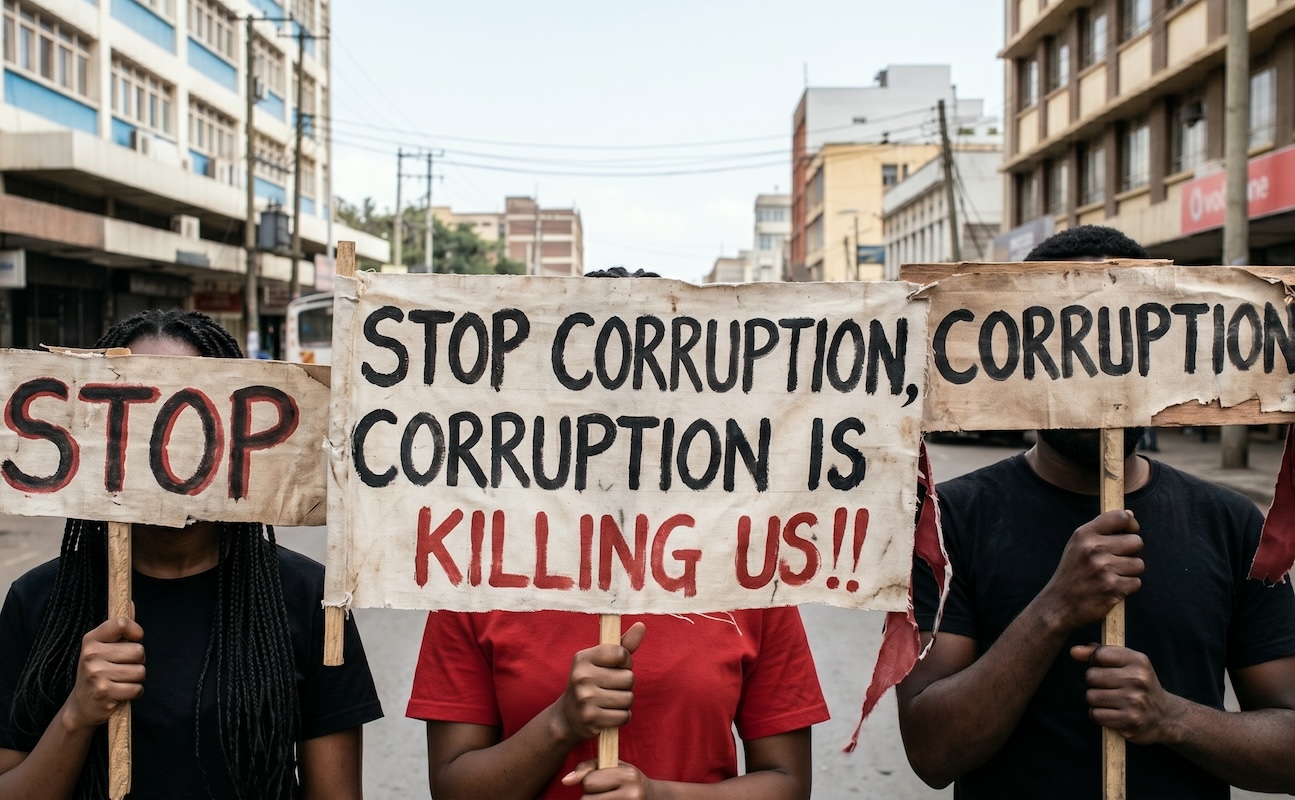
If you woke up this week, walked to the stage, and found that your mathree fare had doubled, you are not alone. If you went to the soko and stared in disbelief at the price of unga, mafuta ya kupika, and basic Sukuma Wiki, the shock you are feeling is shared by millions of wananchi across this country.
For the ordinary Kenyan, life has suddenly become a brutal mathematical impossibility. Our mishahara remain frozen in time despite recent Labour Day “increases”, yet the cost of simply existing is skyrocketing by the day.
When you ask for an explanation, the politicians, their pet economic pundits and government bloggers point vaguely to “global supply chains” or “the war in Iran.” They throw around complex financial jargon to justify the pain, hoping you will accept it as a tragic act of nature.
But this crisis is not an act of nature. It is a man-made shockwave, born from the collapse of a dying global empire, and weaponized by local comprador elites who see your suffering as a business opportunity. To understand why your pockets are being emptied, we have to look past the smokescreens in Nairobi and examine exactly what is happening thousands of miles away in the Persian Gulf, and how the architecture of the global economy was perfectly rigged to make you pay for a war you have absolutely nothing to do with.
Distant War, Local Bill
Right now, the United States and Israel are locked in a catastrophic, unwinnable military standoff with Iran. For decades, the global order was maintained by a simple rule: Washington possessed absolute military dominance, and anyone who defied that unipolar architecture was quickly and violently crushed.
That illusion of invincibility shattered earlier this year. The US military, despite deploying massive naval armadas and dropping thousands of smart bombs, failed to break Iranian resistance. Because the American public has no appetite for a multi-trillion-dollar ground invasion, the empire is trapped. Washington has defaulted to what it knows best: a long war of attrition, grinding aerial bombardments from a safe distance, refusing to admit strategic defeat.
Iran, for its part, cannot meet the US Air Force in a direct dogfight. So it changed the terrain. Sitting on the edge of the Strait of Hormuz, the narrow waterway through which roughly a fifth of the world’s daily oil supply plus a substantial share of global liquefied natural gas, fertilizer and industrial chemicals must pass, Iran has effectively turned that artery into a contested zone. Whether by direct interdiction, by proxy attacks on shipping, or by the simple threat that makes insurers refuse to write policies, the strait is no longer a free passage.
Let us be precise. This is not a defense of the Islamic Republic, which is itself an authoritarian theocracy with its own bloody record against its own people, against women, against ordinary Iranians. It is a description of the architecture. Iran has demonstrated that a state with sufficient asymmetric capability can hold a critical chokepoint of the global economy hostage. The empire has demonstrated that it cannot bomb its way to a solution. The world economy is the casualty. And in a war of economic attrition, the casualties are not soldiers in some distant desert. They are working-class families in the Global South.
The Weaponization of Distance: How the Empire Taxes the Poor
You might wonder why a naval standoff in the Middle East instantly doubles transport fares in Eastleigh, Kayole, Mukuru, Kondele, and Kibera. The answer lies in the deep, structural injustice of the extractive global financial system.
For over half a century, the global economy has been forced to run on the US dollar. To buy fuel, fertilizer, or heavy machinery on the international market, countries must use dollars. This system, dollar imperialism, ensures that when a crisis hits, the core of the empire is insulated while the periphery bleeds.
When the Strait of Hormuz is choked, the global supply of crude oil plummets, and the price of whatever oil remains skyrockets. Because Kenya is an import-dependent economy with a chronically weak shilling, we are forced to spend massive amounts of our depreciating currency just to secure the basic energy required to keep the lights on, matatus and the lorries moving.

Render of a chessboard decorated with a map of the earth and with pieces decorated with the American and Iranian flag. Photo: This is Africa Library.
This is imported inflation. Every time a missile is fired in the Persian Gulf, the cost of transporting a sack of mahindi from the Rift Valley to a soko in Mombasa multiplies. The cost of the fertilizer needed to grow that maize multiplies. The cost of the diesel powering the factory that processes our basic goods multiplies.
The unipolar global architecture promised that deep integration into global supply chains would bring stability and prosperity. Instead, it built a hyper-fragile system that privatizes the profits of globalization for Western corporations and local billionaires, while violently socializing the risks down to the most vulnerable. The financial warfare between Washington and Tehran is being subsidized by the poorest consumers in the global economy. You are paying the empire’s war tax every time you board a mathree.
Disaster Capitalism Wears a Kenyan Face
While the geopolitical reality is grim, it is only half the theft. The other half is happening right here at home, dressed in the language of “hustler” patriotism and economic necessity.
There is a well-known rule among extractive elites: never let a good crisis go to waste. For our local political leadership, this global conflict is not a tragedy. It is the perfect alibi.
This global conflict is not a tragedy. It is the perfect alibi.
When the macro-economy shocks hit, cartels and the politicians who serve them use the chaos as cover for rapid wealth extraction. The political class stands behind podiums, on top of 4×4 fuel guzzlers and blames the crushing cost of living entirely on the Middle East, deploying the war as a convenient shield against any question about years of domestic economic mismanagement, reckless sovereign and odious debt accumulation, and the routine looting of public coffers.
But the smokescreen of global instability conceals a more specific crime. Consider the proximity. Suleiman Shahbal, Gulf Energy’s founder, cashed 2.4 billion shillings from the Rubis buyout in 2019 and migrated laterally into the political and regulatory architecture surrounding the same sector he exited. Francis Koome Njogu, who banked another 1.9 billion shillings from the same deal, now sits on the National Investment Council by presidential appointment, advising the very government whose largest petroleum contract flows to the company he runs. The President himself has, since the Uhuru years, been publicly associated with the Shahbal political and business network. Under his administration, Gulf Energy has graduated from downstream fuel marketer to upstream oil explorer, with its affiliate Auron Energy acquiring Tullow’s entire Turkana working interest in September 2025 for 120 million dollars. The Kenya Pipeline Company privatisation is in motion. The same names appear in every room where the strategic assets of this republic are being parceled out.

As of late 2025, Kenya’s public debt reached approximately 67% of GDP, exceeding the legal limit of 55%
Ask yourself: which Kenyan president has ever signed away national strategic assets to companies in which he had no interest? Which administration has ever engineered a Government-to-Government deal that bypassed open tender, locked in three handpicked beneficiaries, and shielded them from the 30 per cent corporate tax for nothing in return? Which serving president has been credibly accused of selling the Kenya Pipeline Company to a cross-border partnership in which he, by every credible account in Nairobi’s political marketplace, holds a beneficial interest? The architecture answers itself.
Which Kenyan president has ever signed away national strategic assets to companies in which he had no interest?
And here we must say the thing plainly. The African proxy is not a loophole. It is the operating system. A president who owned a fuel company outright would face audit, scrutiny, and prosecution. A president whose university friend’s brother’s company holds a 23 per cent silent stake through a Mauritian holding vehicle faces nothing. The proxy is how the postcolonial state was designed to be looted; through structures the inherited extractive colonial legal system was never equipped to penetrate. To pretend we do not see the proxy is to participate in the lie. The wananchi see it. Every matatu tout, every mama mboga, every boda boda rider, every furloughed civil servant, can name the companies our politicians own. The documents lie. The people do not.
This is the local arithmetic of your suffering. The Gulf War doubles the global landed cost of fuel. The cartel doubles it again at the Mombasa terminal. The retail margin doubles it a third time at the pump. Three layers of theft stacked on the back of one trip to the stage. The same hand that signs the G2G letter legalizing the first theft also signs the privatization order locking in the second. The empire’s war and the local cartel are not separate crises. They are the same crisis, executed at different altitudes.
Forty Years of Thinking, Zero Years of Planning
There is a clip from 1987 making the rounds. A young Donald Trump, then a property developer with presidential ambitions, telling an American interviewer how he would handle the Persian Gulf. His proposal, delivered with the confidence of a man who has never been wrong in a room he paid for, was simple. Go in. Grab one of their big oil installations. Grab it and keep it. Get back your losses. Enrich America in the process.
Forty years. Forty years he carried that thought around, polished it, repeated it in interviews, built a political career on the swagger of it. And when he finally arrived in the Oval Office with the authority to execute the plan, this is what we discovered: he had spent four decades thinking about the prize and zero seconds thinking about the plan. The 1987 soundbite was never refined. It was never tested against the actual geography of the Gulf, the actual economics of the global oil market, or the actual capabilities of an adversary that had also spent forty years preparing but preparing for him.
What we are watching now is the catastrophic collision between a 1987 fantasy and a 2026 reality. The empire arrived at the Strait of Hormuz expecting to find the world of Reagan’s second term, a world where American carriers could sail anywhere and dictate terms through the simple threat of overwhelming force. Instead, it found a coastline transformed into a fortress of cheap, lethal, asymmetric weapons. The Marines were not going to march onto an oil installation and hold it. The carriers were not going to project unchallenged power. The plan that survived four decades inside Trump’s head did not survive four days of contact with the actual Persian Gulf.

File Photo: William Ruto of the United Democratic Alliance and his running mate Rigathi Gachagua. Photo credit: William Samoei Ruto via Facebook.
And here is the lesson that should arrest every Kenyan reader. This is what happens when a man spends forty years preparing for personal power and zero years preparing to govern. This is what every empire and every president built on this pathology eventually delivers to the people who depend on them. A long, vain ascent. A confident announcement. A catastrophic collision with reality. And the bill is always sent to the working people.
Look closer to home. “It is better to die of debt, than to die of poverty,” President William Ruto says. Our own President spent decades climbing toward State House, building the networks, accumulating the proxies, learning every back staircase of Kenyan power. He arrived in 2022 with a hustler nation manifesto polished by years of repetition. And what plan, exactly, survived contact with the actual economy? The shilling collapsed. The cost of living doubled. The G2G deal enriched three handpicked cartels. The streets filled with #GenZs being shot for protesting taxes designed to service debts the political class had no plan to repay. The same pathology. The same long preparation for the prize and the same missing plan for the people. The same bill, sent to the same address.
“It is better to die of debt, than to die of poverty,” President William Ruto says.
The empire’s war and our administration are running the same operating system. Forty years of preparation for personal power. Zero years of preparation for governance. A confident grab at the resource. A catastrophic failure on contact. And a working class left to pay for a fantasy that was never going to work in the first place.
The Contradiction We Cannot Flinch From
Here is the difficulty we must name directly, because it is the difficulty the cartels are counting on us to evade.
The collapse of the unipolar order is necessary. The empire that designed dollar dependency, that engineered the World Bank and IMF conditionalities, that bombed our continent into submission for half a century, deserves every crack now appearing in its architecture. We have argued for years that the unipolar world had to end before any African future was possible.
And yet. The disorderly collapse of that empire is what is currently emptying your pocket. The transition is being financed by the poorest. The vacuum left by the retreating empire is being filled, in the short term, by exactly the same comprador cartels that flourished under it. The fact that the old system is dying does not, by itself, deliver us anywhere good. Liberation does not arrive automatically. The cartels are already moving to position themselves as the indigenous successors to the empire, ready to extract under a new flag exactly as their predecessors extracted under the old one.
The strategic question facing us is not whether the empire falls. It is falling. The question is what we build in the space its collapse opens up, and who builds it. If we leave that space empty, the cartels and the warlords will fill it. They are already trying.
Building Our Own Architecture: The Return to UTU
This is the work of UTU. Not as an abstract philosophy, but as the working architecture of an alternative. Umuntu ngumuntu ngabantu. Mtu ni mtu juu ya watu. A person is a person through other people. Our survival is inherently tied to one another. The market priests have spent fifty years teaching us to forget that. The cost-of-living crisis is teaching us to remember it.
When centralized, globalized systems fail to deliver basic human dignity, relying on them is no longer an option. We are being forced by history to build our own resilience, and the building blocks are already in our hands.
Start with what we already have. The Kenyan chama is not a quaint social formation. It is a solidarity economy unit, already capitalized, already trusted, already operating outside the formal banking architecture the empire built to discipline us. Multiply it. Federate it. Connect chamas across counties through M-Pesa rails into community treasuries that can finance local food production, decentralized solar mini-grids, community-owned cold chain, and farmer-controlled fertilizer cooperatives. The SACCO movement, which already holds hundreds of billions of shillings of working-class savings, is the most underutilized political and economic asset in this country, the reason the political cartels are now targeting it. It does not need foreign investment. It needs political imagination and disciplined organizing.
On energy: a single doubled mathree fare is the receipt for our dependence on a fuel supply chain that runs from the Persian Gulf, through Mombasa, through a cartel. Every kilowatt of community-owned solar, every biogas digester on a smallholder farm, every micro-hydro project on a county river, is a small act of secession from that supply chain. We have the sun. We have the rivers. We have the engineers. What we have lacked is the organization.
On food: the same Rift Valley that feeds Mombasa is being squeezed by fertilizer cartels whose prices track the Gulf War as faithfully as the mathree fare does. Community seed banks, agroecological cooperatives, and county-level food sovereignty plans are not romantic alternatives. They are infrastructure for survival in a world where global supply chains will keep breaking.
And on political architecture: this is the work of #WeThePeopleKE. The People’s Manifesto we are building, county by county, justice centre by justice centre, from Mukuru to Kayole to Narok, is not another NGO document. It is a binding declaration by the wananchi, for the wananchi, that reclaims our economic and political agency from the cartels and the comprador class that fronts for them. The 2027 election is not a destination. It is one tactical battle in a much longer war for sovereignty.
The Spell is Broken
The mathree fare has doubled. The empire is bleeding. The cartels are feasting. The President’s friends are buying the oilfields the colonizers used to own.
But the spell of the old world has been broken. The unipolar dominance that dictated our economic limits is falling apart, and the local proxies who fronted for it are losing their cover. As the old system burns itself out in wars of attrition and economic blockades, the architecture that protected the theft is showing its seams.
The question is no longer whether the empire falls. It is falling. The question is who we will be when it does, and what we will have built in time. The cartels are organized. The empire is organized. The compradors are organized. The only force that has not yet fully organized itself is us.
It is time.
- https://kenyainsights.com/the-teflon-company-how-gulf-energys-insiders-built-billions-on-kenyas-fuel-and-walked-away-clean/
Follow This Is Africa on Twitter and Facebook to join the conversation.


