
Politics and Society
The Pan-Africanism of it all
Oh. The definition of PanAfrican must have changed recently.

I love Adelle Onyango.
I want to say that upfront, because what now follows started with a post of hers on Instagram – a reaction to what’s been happening in Nairobi these past two days – and I want you to understand why her name, specifically, unfurling this thread of thoughts in my mind, isn’t an accident.
If you don’t know Adelle, in one take: In all the time I’ve known her, she’s one of those people whose commitment to saying the true thing, even in the most uncomfortable of spaces, isn’t a performance. It’s just what she does.
October 2021. Emmanuel is hosting a summit in Montpellier, France. The short version: No heads of state invited. Thousands of young Africans instead – artists, businesspeople, athletes… The stated purpose: To demonstrate a “new” France-Africa relationship, built on listening to youth.
Adelle takes the stage. Emmanuel is part of her audience – on stage with her, in fact, as part of a panel presentation. He’s seated to her right, doing that thing that big men with power do to show that they are paying attention even when they’re being told things they don’t like: Nodding and taking notes. Even with the slight quiver in her voice, her eyes radiate her conviction.
“We as Africans feel the pain of colonisation every single day. The lack of a clear and strong acknowledgement of the continent’s pain on this destructive past results in scepticism. What we end up with is scepticism of what exactly does France stand for… In fact, the air of denial that France chooses to sit in is uncomfortable, not only for Africa but also for France, and it does no good for either one of us. How can you trust the source of your pain when the source doesn’t acknowledge it?”
Then she unloads the question:
“How strong can a relationship that is built on pain, that is built on scepticism, and that is built on lack of trust really be?”
(I’m revisiting all this with good reason, so stay with me for a moment.)
And she continues with:
“We, not just as a team here, but all of us in this room, and the 5,000 who helped with the report, and the millions more on the continent, and off of the continent, want a commitment from you, Mr. President, that you will join us in the eradication of La France-Afrique, which is a very unfair dominance, and it has to end.”
The room erupts.
Later, she says this about why she spoke the way she did:
“When presidents meet they cannot tell the truth as they have deals they want to seal. But for me, I had no deal to seal.”
Macron is in that room. He hears her. He hears all of it. He hears the specific indictment, delivered by a young Kenyan woman with no deal to seal, in front of thousands (and later, thanks to the world we live in, millions) of witnesses.
He deflects. He says he doesn’t believe in “a politics of repentance.” He promises France would introduce an honest assessment of its colonial past into school curriculum. Bla-bla-bla, and all the non-commital politico-speak.
He doesn’t apologise. He doesn’t commit to ending la Françafrique.
And then. And then.
Five years later.
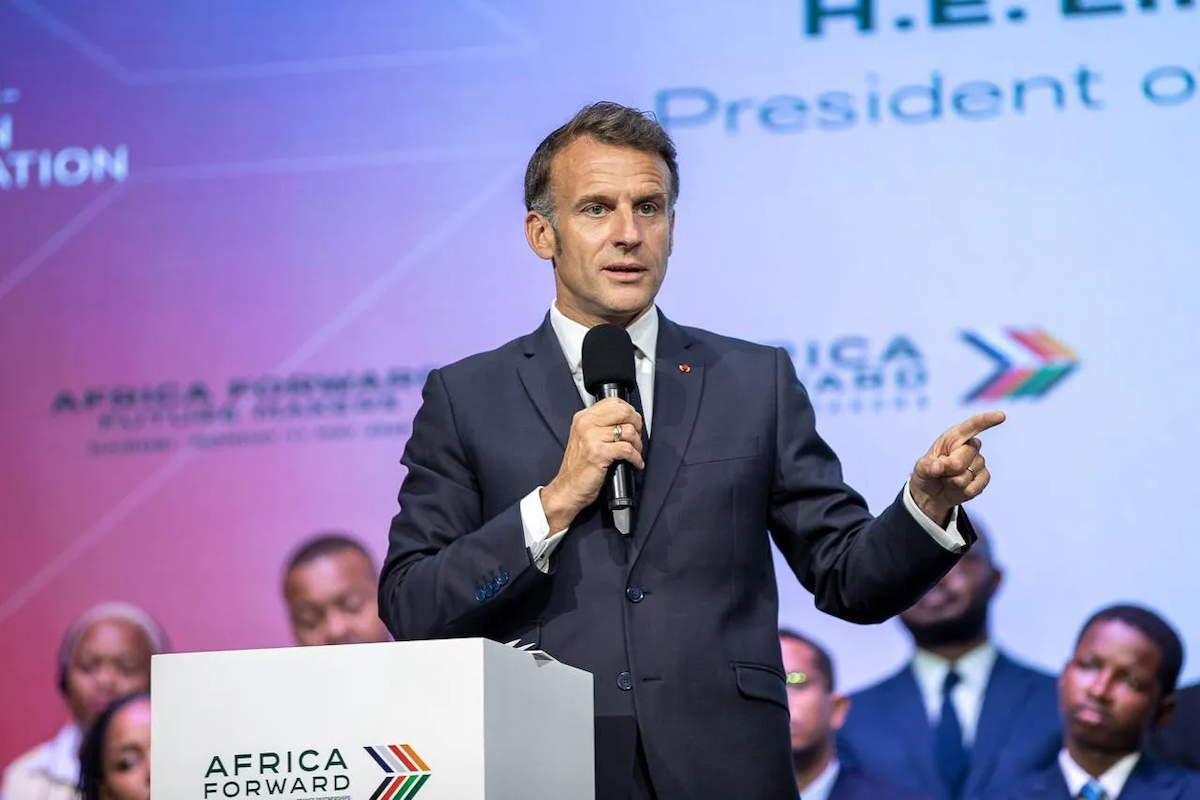
Emmanuel Macron arrives in Nairobi, looks at a room of African heads of state and young Kenyan leaders, and declares, “We are the true pan-Africanists.”

He is, of course, part of the “we” he’s just referred to. Declared with the pomposity of Ludwig Krapf discovering Mt. Kenya.
I’ve only been online intermittently for most of the day. It’s 10.49pm as I start typing this – because I’d just been on Instagram, and Adelle’s post was the third or fourth on my feed.
It found a nerve, and I’ve been typing, googling, deleting, typing, and repeat ad infinitum, ever since.
Some bits of this may feel rough or unpolished. Good. Take a red pen, and circle your corrections and add your additions.
Chapter I: The pan-Africanism of it all.
I read it again.
I looked for the missing word. The misquote. The out-of-context fragment that, once restored to its surrounding sentence, would suddenly make sense. Surely there was a “not” somewhere. Surely there was a qualifier. Surely “we are the true pan-Africanists” was a badly excerpted portion of a longer sentence that began with “critics say” or “some have argued” or even the relatively humble “we all aspire to be.”
Lol. Nope. There was no missing word.
Emmanuel Macron, President of the French Republic, stood at the University of Nairobi (that’s where it was, right?) on the 11th of May 2026, looked around the room of mostly black faces, and said – without apparent discomfort nor hint of shame – “We are the true pan-Africanists.”
And then. And then.
I want to be precise here, because it matters to what’s coming next. He didn’t just claim the label. He made the case. He said, with his full chest:
“We believe that Africa is a continent.”
Transformative revelation, Manu. Can I call you “Manu”? It’s a Kenyan thing – we shorten names like that. Especially with people we know. You know, partners.
Manu said:
“It is the youngest in the world, and therefore has an extraordinary demographic dividend.”
Manu said:
“It is the one with the greatest growth in the world.”

To be a proper writer, I’m supposed to start with the historical context. The Pan-African Congress of 1919. Du Bois. Garvey. Nkrumah. The OAU. I’m supposed to do the whole thing.
I shan’t do that.
Many have already done the history lesson. Many in West and Central Africa – and across Africa, really – have been dissecting the history time and time again, increasingly so over the last 5 years. They do it with more rigour and fury than I can muster right now, and they name every name that needed naming. Farida Bemba Nabourema does it wonderfully – I’ve linked her piece at the end of this.
Which is why I’ll skip right to the frame of mind, because I’m very curious. The specific frame of mind that makes it possible to stand in Nairobi in 2026 and say that sentence with that degree of composure, full chest. Not rhetorically curious. Actually curious. What is the reasoning? What is the internal logic that arrives at, “I, Emmanuel Macron, representative of the nation that recognised and supported Blaise Compaoré’s government for 27 years after he orchestrated the coup that killed Thomas Sankara, am a pan-Africanist”?
A few things, first.
One: “We believe that Africa is a continent.”
Mr. President. Monsieur le President, Sir. Emmanuel. Manu.
A continent is the baseline entry-level fact about a landmass. The Merriam-Webster dictionary believes Africa is a continent. A Grade Four pupil in Kisumu who has looked at the back of an atlas for exactly twelve seconds believes Africa is a continent. A man in a bar in South Texas who has never left his state and whose entire knowledge of the continent begins and ends at “they have lions” believes Africa is a continent.
Believing Africa is a continent isn’t a political philosophy. It would be bold of me to believe I’m vegan because I had bread and kachumbari for breakfast. By this logic, Google Maps is the most pan-Africanist technology ever created – it knows not only that Africa is a continent, but can locate you within it, to within 3 metres, and will suggest the fastest route to the nearest Airtel Money agent. (Because we’ve left M-Pesa – that app is very annoying.) Is Google Maps a pan-Africanist? Should we be redirecting our solidarity statements to Sundar Pichai?
That’s where Manu started. I tried to find the charitable interpretation and I suppose I can chalk this up to another of my many failures. There is no world in which “we believe Africa is a continent” is a qualifying statement for pan-Africanism. None.
Next.
Two: “It is the youngest in the world, and therefore has an extraordinary demographic dividend.”
Friends. This is a market size assessment.
Let me just – let me say that again slowly. This. Is. A. Market. Size. Assessment.
And, perhaps, a labour force evaluation.
“Demographic dividend” – which refers to the economic growth potential associated with a large working-age population relative to dependents – is a phrase you find in a McKinsey report called Africa: The Next Consumption Frontier. It’s the phrase I’ve heard an actual Unilever executive using in pitch before discussing plans to expand into “underserved markets.” It’s what private equity firms say right before launching their “Africa strategy” arm.
So. Just to be clear. His argument for being a pan-Africanist is that he finds young Africans investable. He is saying: I, Emmanuel Macron (Manu), notice that your young people represent a significant economic opportunity and I would like to be present for that opportunity. Forget what history’s implications for such an assessment brought with it – just know that I, Emmanual Macron (Manu), have seen how wonderfully young and able-bodied your people are.
Because I, Emmanuel Macron (Manu), am panafricanist.
In front of Africans. In Nairobi. In 2026.
Pan-Africanism – the actual tradition – is specifically the political philosophy that said African peoples aren’t a dividend. They’re not an investment opportunity to be assessed on a market day by an outside observer. They are fully-formed human beings, with political agency, with the right to determine their own futures on their own terms. Framing a continent’s young people as a “demographic dividend” – as value waiting to be realised – and specifically by a party whose country was so deeply entrenched in (and enriched by) the shameless extraction of our resources and our very being – is the exact reasoning pan-Africanism was constructed to push back against.
Next.
Three: “It is the one with the greatest growth in the world.”
So France is a pan-Africanist because France has noticed Africa is growing and would like to be present for that growth.
That’s the pan-Africanism.
If showing up when there’s growth makes you a pan-Africanist, then every multinational that launched an “Africa strategy” is a pan-Africanist. Juzi juzi BlackRock were in Nairobi and Nakuru – they must be pan-Africanist. The IMF and its ceaseless assault on Kenyans’ disposable income must be pan-Africanist. The CFA franc – the currency mechanism that kept 14 African economies tethered to the French treasury for decades – was, because we’re following this logic all the way down, a pan-African financial cooperation instrument. The French-trained soldiers who removed heads of state who refused to cooperate were performing acts of pan-African solidarity with the local business community.
We’re all pan-Africanists, guys.
There has to be a name for what he’s doing. “Appropriation” is too light. “Historical revisionism” is too academic. “Audacity” is accurate but incomplete, because audacity implies awareness of the risk, and the composure with which Macron delivered this suggests the risk-detector isn’t firing.
Give me a moment as I google something.
(insert wait music here)
Ok. We may have something here. It’s sounds academic enough to do a bit of lifting.
Let’s call it victorious retroclaiming: The act of claiming ownership over what you failed to destroy. The logic of the person who claims dominance over something, fails, then later announces that the thing which survived their ruthless attempts at extraction and destruction is, in fact, their contribution to the world. That’s what this feels like.
And yet.
And yet the failure of the project of destruction grants no ownership over what you tried to erase. It grants you only the lesson – and it’s only a lesson if you’ve actually registered and taken it.
Pan-Africanism survived France. It survived the napalm over Cameroon – documented by survivors and historians across decades, confirmed in broad terms by a joint Franco-Cameroonian commission in January 2025, and to this day neither confirmed nor denied by France officially. (Typical.) The counterfeit currency flooded into Guinea after Sékou Touré had the dignity to say “Non” to de Gaulle in 1958. The poisoned cups. The midnight arrests. Thomas Sankara – who stood before the OAU in July 1987 and told African leaders to stop paying their odious colonial debts, who said, “I speak not only on behalf of Burkina Faso but of all those who suffer,” who was assassinated ten weeks later. Whose killer France then recognised as Burkina Faso’s legitimate president and supported for twenty-seven years of uninterrupted rule.
Twenty-seven years.
Pan-Africanism survived all of it. And Macron’s argument, distilled, is: therefore it is mine too.
Chapter II: The exiled summit of it all.
Kenya. English-speaking Kenya. Never a French colony. No CFA franc history. No French administrative buildings because France never built any here.
This is where France chose to hold its Africa summit.
The France-Africa Summit has existed since 1973. Always in France or Francophone Africa – in the places France had colonised, whose currencies it controlled, whose military it maintained, whose leaders it managed when necessary. The heartland. Mali. Burkina Faso. Niger. Côte d’Ivoire. Cameroon. Senegal.
Mali, Burkina Faso, and Niger are not hosting this summit.
I won’t be ambivalent on this: The phrase that a lot of press outlets use – “France’s military withdrawal from West Africa” – is doing a lot of diplomatic work on France’s behalf.
France was expelled.
Mali told French forces to leave in 2022 and requested the withdrawal of the French ambassador. Burkina Faso followed in 2023. Niger gave France forty-eight hours to remove its ambassador after the July 2023 coup. Senegal’s president, Bassirou Diomaye Faye, said French military bases were incompatible with his country’s sovereignty and shut them down.
Expelled. Not “withdrew.” Not “reorganised its footprint.” Expelled.
France 24, covering the summit this week: The event “comes amid France’s military withdrawal from West Africa and renewed debate over its post-colonial role on the continent.”
Renewed debate.
The people of Mali, Burkina Faso, and Niger looked at what French “partnership” had produced – actually produced, in terms of tangible outcomes for themselves as the actual people living in those countries – and they made a judgment. This is not working for us, they said. It has never worked for us. Leave.
And then France needed somewhere to hold its summit.
In comes the hustler to rescue Manu. The man of the people to roll out the red carpet and tarmac the [very specific] Nairobi roads. The bestest president to ever president is here, at your service, Manu. Just tell me what you need, and I gatchu.
You’ve been rendered into exile from West Africa? Worry not, because I gatchu. Come hivi Nai, nikushow love.

Chapter III: The sahani za wageni of it all.
In many homes in this country – you know this if you’re Kenyan – there are two kinds of crockery. (I like that word. “Crockery.” I don’t know why. I’ve just always liked it.)
There are the everyday plates. Oftentimes they’re plastic, sometimes they’re melamine, sometimes they’re enamel-coated metallic. The plastic ones are often slightly warped, because once upon a time, someone left it too close to an open flame. The melamine ones are often chipped – they fell at some point, sometimes reserved for when the regular anko or antie pops by.
And then there’s the sahani za wageni.
The good plates. Glassware, often. Wrapped in an old newspaper at the back of the top shelf. Brought out when the in-laws arrive from upcountry. When mum’s jumuiya visits. When someone important is coming and the house needs to demonstrate, at the level of crockery, that we are not a family who eats from cheap chipped plates.
The food is the same food, but a little extra Royco and a few extra tomatoes thrown in – a huge deal in this economy. The fancy table mats are even brought out. We prepared for you.
On the 9th of May 2026, the Government Spokesperson’s Office issued a public advisory. Heavy VVIP movement. Key transport corridors. Summit period. Plan accordingly. Mombasa Road. Lang’ata Road. Thika Road. Limuru Road. Kiambu Road – intermittent stoppages. City Hall Way. Parliament Road. Harambee Avenue. Taifa Road – fully closed from midnight on May 11th. Conference vehicles only.
Quite literally, “Mjipange.”
The Nairobi Regional Police Commander added: Those with flights should arrive at JKIA five hours ahead of their scheduled departure time. Five hours. If you had a 7am flight on the 12th of May, you were being asked to leave for the airport at 2am. In the morning. Because Emmanuel Macron was coming.
Sahani za wageni.
The everyday plates – the Nairobians who use Mombasa Road to get to work, the ones with a flight to catch who can’t miss it because they are not VVIPs, the ones with a matatu to board at 6am who discovered the route was closed – the everyday plates went to the back of the cupboard.
The crockery doesn’t choose when it comes out. It is chosen. And the bestest president to ever president, whose instruments of power has been frequently documented brutalising everyday Kenyans, decided that the capital city of this sovereign land shall be bent to fit an image that its citizens have been beaten and killed for demanding.
Sahani za wageni.
There’s a theatre to when visitors come to your house. I don’t know how universal it is amongst us colourful cultures, so I shall speak of the Kenyan context I know of.
First, the thermos that’s accompanied by the universal question: “Utakunywa chai?” It’s more rhetorical than anything else – the thermos is already there, along with the saucer, the cup, and the bowl of sugar.
As you’re just about to take your last sip of your second cup of tea, a jug with warm water and a basin with a piece of bar soap inside appear in front of you. It’s time to wash your hands – food is ready. The question is there along with the jug and basin as a formality. The food is ready, and it must be eaten.
And when the food is done, and when that jug and basin appear before you again, your cup has already been refilled, and a small saucer of mandazi is right next to it.
Every time a government needs to enter a room it doesn’t quite belong in, or rehabilitate an image that has been comprehensively rejected in the places it used to occupy, this is the exact theatre it reaches for. You know it. You’ve seen it before. The performance of hospitality at the cost of the home’s inhabitants.
And we all saw it play out over the last few days.
The morning jog with the great homegrown athlete.
The cooking session with the beloved local chef.
The dinner with the local celebrities.
All things scripted to look as natural as possible, but that almost certainly had to be planned, approved, and coordinated at multiple levels several times over. Because you have to soften the ground before you strip it dry. And there are proven ways to do it.
I’ll get back to that last point later.
Here’s what I want to say carefully, and I want to be precise about it because I prefer to think in systems rather than in individual responsibility, as valid as the latter also is.
I’m not calling out Kipchoge. I’m not calling out Ombachi. Nor Bien, nor Sarah, nor any of the artists in Nairobi (or in Cape Town – yes, this is a very specific reference) who showed up and made things for someone who needed their warmth. They have their own agencies, their own calculations, their own reasons, and this piece isn’t about burning them. They have their peers, who’ll have those conversations with them. Nviiri, for instance, has no qualms about having that conversation. At the same time, there’s an argument to be made about not being able to litigate that for which you’re not present.
Multiple sides of the same coin.
What I want to talk about is the system itself.
The system that, each time it needs to enter a room that hasn’t invited it, reaches for the most luminous thing it can find nearby – the first sub-two-hour marathon runner, the beloved roaming chef, the celebrated singer – and borrows their credibility for the duration of the image. The system in which Kipchoge’s extraordinary relationship with running becomes the visual language of a “new partnership” with Africa. In which Ombachi’s cooking becomes a “cultural exchange.” In which the whole arrangement is described, repeatedly and without apparent irony, as “relaxed.”
The Africa Forward Summit website said explicitly that it would “bring together States, businesses, young people, artists and diasporas. Because the relationship between France and Africa cannot merely be declared, it must be built on the ground by innovators, entrepreneurs and creatives.”
Built on the ground. That’s the phrase.
The creatives prepare the ground. The technocrats and the deal-makers take over after the creatives have done the soul work.
And the creatives are brought in at very specific points, and wheeled out when it’s yet again inconvenient to have human soul in the room. Until the next time we need their services.
Sahani za wageni.
Chapter IV: The Creation in Motion of it all.
There was a session at the Africa Forward Summit called Africa Forward: Creation in Motion.
Before we get to that, let me share with you something that any creative practitioner in a room full of people who aren’t is all too familiar with.
There is a structural position that creative sessions occupy in high-stakes summits. We’re the soft part. The warm part. The part that happens before the “serious” stuff begins, or at the end of the day when the actual decisions have already been made, or on the day two programme when people’s attention is starting to drift and someone thought it would be nice to have some artists in to “liven up the programme”. We’re the room where you’re allowed to laugh and be surprised and maybe even clap. Then when it’s time for policies to be written…
Everyone in these rooms knows this. The creatives know it. The organisers know it. The audience knows it. And the audience behaves accordingly – which is to say, they behave like people in a warm, informal, culturally-themed, feel-good session, rather than like people in a high-stakes engagement.
The organisers forgot to brief the audience on the correct behaviour.
Or rather: Emmanuel, in his repudiation to the audience’s behaviour, revealed what the room actually was.
Artists and young speakers were on stage. The audience was having their own little side-conversations, with the creative conversation on stage serving as background noise to whatever important things they – these very important fat cats – were discussing.
Macron was not on stage. He was in the front row, an attendee, scheduled to speak later.
Then he got up.
He walked to the podium. The moderator looked up, understandably confused – he was not scheduled:
“Already? You’re not waiting your turn?”
He took the microphone.
“Excuse me! Everybody! Hey. Hey. Hey.”
The room settled. He continued:
“I’m sorry, but it’s impossible to speak about culture, to have people like that – super inspired, coming here, making a speech – with such a noise. This is a total lack of respect. So I suggest: if you want to have bilateral discussions or speak about something else, you have bilateral rooms, or you go outside. If you want to stay here, we listen to the people, and we’re playing the same game.”
I can’t believe I’m about to agree with something Manu said, and yet here I am.
Apparently broken clocks can also tell the time at very specific points in the day.
Two things just happened simultaneously, and I need us to see both of them.
The first: Macron confirmed the critique that creative industries have lived with for the entire history of institutional summitry. Creative sessions are treated as the relaxed, fun, optional part of the programme. The audience was noisy because the room had been set up – in its informality, its cultural framing, its position on the schedule – as the relaxed, fun, optional part of the programme.
What Macron did by wagging his finger at this audience served to accidentally prove the point. Nobody wagged a finger in the AI policy roundtable. Nobody told the energy investors to quiet down and show respect. The command to be still and attentive is issued precisely in the rooms where power has decided the content is soft enough to permit noise, and then decided it doesn’t like the noise. Creation in Motion got a French finger-wag because Creation in Motion is where the informal stuff happens. The non-important stuff, before the actual adult conversations.
(Again, I can’t believe I’m agreeing with Manu on something, but what needs saying has to be said.)
The second: Macron is right that the audience was being disrespectful. To the artists on stage. To the people standing up and saying something, addreessing something important, but being treated like background entertainment, like the movie on Netflix you have on as noise in the other room as you wash the dishes. The disrespect was real. And it was structural – it was built into the programme, built into how these people, these alleged leaders, view their own people.
That French finger-wag pointed to a symptom creatives live with daily. We get this from everywhere. From the institutions that commission them for a conference “to bring some energy”. From the summits that schedule them in the afternoon when the deals are already done. From the programme designers who use the word “creatives” as a category adjacent to “youth” and “diasporas” – which is to say, adjacent to the people whose presence legitimises the event whilst being excluded from determining its outcomes.
And it had to take a whole Macron, wagging his presidential finger, to bring the room to order and confirm, accidentally, that yes – actually, the creative session is supposed to be serious.
We’re playing the same game. He said. The creative part is part of the game.
And, for a deeper sense of irony, it took a frenchman – a colonial power whose core strategy was assimilation – to point out that creativity and culture is as much the point as anything else.
Chapter V: The William of it all.
“We are neither looking East nor West. We are looking forward.”
– President William Ruto, Africa Forward Summit, May 11, 2026.
I’m sure the speechwriters who penned that gave themselves huge high-fives for that one.
“We are looking forward” is beautiful political language. It sounds like motion. Like intentionality. Like a country that has done the analysis and arrived at principled, strategic independence.

What it is, grammatically, is a refusal to turn around.
Because if you turn around – if you look at what French partnership has actually produced in the places that are no longer hosting this summit – the sentence “we are looking forward” then sounds like wilful ignorance. It sounds like an active, concious decision to keep the view behind you out of the frame.
I live here, in Kenya. Ruto is, by law, at this moment in time, my president. I live in the city that closed 8 major roads for this summit. The decisions at KICC are made in my name, whether or not I was in the room or asked. It definitely feels like there’s something very broken about the implications carried in many of these last sentences.
Kenya and France signed 11 bilateral agreements during Macron’s visit. (I think the count stands at 11 – correct me if I’m wrong.) A nuclear energy plant. Modernised transport. Sustainable agriculture. Investing 700 million euros at Mombasa port. And the defence cooperation agreement ratified alongside the summit grants French troops operating in Kenya legal protections equivalent to diplomatic immunity. Reports indicate approximately 800 French soldiers had already arrived in Kenya before parliament formally ratified that agreement. 800 soldiers. Before any formal vote.

Ruto is not a naive actor. The calculation being made here is not the calculation of a government that doesn’t know what it’s doing.
What’s also true is that it’s one in a series of calculations that call into question where loyalties lie – whether it’s to their own people, or elsewhere; whether it’s serving their people’s best interests, or rolling out the red carpet for a historically certified colonial power with selfish imperial interests, currently led by the man who approved his own application to the status of pan-Africanist.
What is also true is that nobody in the room asked the question that the people of Mali, Burkina Faso, and Niger answered in the street, with their feet, over several years. William, from all appearances, certainly hasn’t.
Chapter VI: The Macron of it all.
Let me tell you a story.
Actually – let me tell you the same story, several times. Because it keeps happening.
2017. Burkina Faso.
Macron is the new kind of French president. No colonial nostalgia. A new relationship. He stands at the university in Ouagadougou in front of students and says, “Sometimes you talk to me like I’m still a colonial power. But I do not want to deal with electricity in universities in Burkina Faso. It is the work of the president [of Burkina Faso].” He gestures at President Kabore, who is sitting on the same stage.
Kabore stands up and walks out.
Macron calls after him: “He’s leaving… Stay there! So, he went to repair the air conditioning.”
The students laugh. Then go quiet.
New relationship.
2017. Hamburg G20.
A journalist from Côte d’Ivoire asks why there has been no Marshall Plan for Africa. Macron replies: “The challenge of Africa is completely different, it is much deeper. It is civilisational today.”
Civilisational. Interesting choice of words.
New relationship.
2017. Hamburg G20.
Macron, at a press conference, on the question of African development: “When countries still have seven to eight children per woman, you can decide to spend billions of euros, but you will stabilise nothing.”
New relationship.
2020. Pau, France.
France summons the leaders of the G-5 Sahel to a meeting in France. On French soil. Macron demands they publicly declare their support for continued French military presence in their countries. In their countries. They travel to France to endorse French troops on their own soil.
They were pretty much summoned to France, actually.
It tasted very… colonial. Many people of the Sahel didn’t like it. At all.
Coups followed.
New relationship.
2021. Montpellier.
Three thousand young Africans. No heads of state. Adelle Onyango in the panel. She tells him – what is, in my view, a truth in absolute – that France is in denial about its destructive past. That the relationship is built on pain and scepticism. That Françafrique has to end.
He deflects. He says he doesn’t believe in “a politics of repentance.”
New relationship.
2025. Paris, the ambassadors’ conference.
Macron describes the expulsion of French forces from Mali, Burkina Faso, and Niger – the events that required him to find a forwarding address for this very summit – and frames it as France’s own strategic decision.
He calls the leaders who expelled his soldiers “ungrateful.”
New relationship.
2026. Nairobi.
“We are the true pan-Africanists.”
800 soldiers, already in the country. With immunity.
New relationship.
There’s a pattern somewhere in here, I think.
The thing about Macron – and I don’t mean this as a compliment, I mean this as my own diagnosis – the thing is: He believes it. And he’s shown us what he believes. Every single time.
And it’s a thought that makes me shudder.
A cynical actor would occasionally update. Would see what happened in Mali, in Burkina Faso, in Niger, and think: Maybe the play needs changing. Macron doesn’t update. The “civilisational” comment wasn’t cynicism – he was sincerely explaining his view. The Pau summoning was not a conscious power move he knew was transgressive – he genuinely saw nothing wrong with it. The “ungrateful” comment wasn’t strategic framing – he actually believes the leaders who expelled his soldiers were being ungrateful.
He’s shown us what he believes. How he sees us. Every single time.
And now: We are the true pan-Africanists. Said with composure. Because he means it.
And, I think, he means it because someone has fed him a frame he was all-too-happy to accept. Oh, the William of it all.
Cynicism, you can argue with. Cynicism, you can expose. Macron – Manu – is being sincere. He can’t be shown to be a hypocrite because he isn’t one. He believes himself. He believes in the benevolence of colonial power, and that we should be grateful to him and his ilk. So when some hustler in Nairobi seizes upon his ego that was wounded when the people of Mali, Burkina Faso, and Niger gave him feedback, he interprets that as gratitude. And imagine when the gratitude comes from someone whose first offer is immunity for your troops? Imagine not doing anything wrong yet, and being promised that you can do whatever you want without consequence. Actual gratitude, even before stepping onto the soil.
Wow. Furaha ilioje.
Chapter VII: The counter-summit of it all.
While the Africa Forward Summit was happening at KICC, a different gathering was taking place elsewhere in Nairobi.
The Pan-Africanism Summit Against Imperialism. PASAI. Organised specifically in response to the Africa Forward Summit. Activists, scholars, organisers who understand pan-Africanism as the political tradition it actually is, not as a rebranding exercise for a government being diplomatically expelled from its former territories. Same city. Same days.
Pan-Africanism, in the same city, saying, “Not in our name.”
Chapter VIII: The nuclear energy of it all.
That agreement, the one that was signed about nuclear energy… Is a copy of it publicly available? I’m just curious, but I’m sure the terms are excellent.
Chapter IX: The everything of it all.
“Let’s also not forget that whilst we in this room are here because we want to change and repair this relationship, there are some who are benefiting from this current dysfunctional relationship. Be it private businesses from France on the continent with non-ethical practices or corrupt individuals and groups from both France and Africa… So this honest interrogation is a very important first step because the strengths and weaknesses of this current relationship will dictate the success or failure of our collective future relationships.”
– Adelle Onyango, at the Africa-France Youth Summit in 2021.
It’s 2026. And Emmanuel Macron, Manu, standing in Nairobi in 2026, looked at a room filled with black faces and said, with his full chest: “We are the true pan-Africanists.”
Can you smell that? There’s some empire in the air, and it smells foul.
Related reading and references. (This will, in all likelihood, expand over time.)
- The history lesson this piece deliberately avoided, because Farida Bemba Nabourema already covers it so well: “You Are Not A Panafricanist and Can Never Be.”
- The counter-summit: Pan-Africanism Summit Against Imperialism (PASAI), Nairobi 2026.
- Adelle Onyango’s Instagram post that served as the spark for this.
- Adelle Onyango’s speech at the New Africa-France Summit, Montpellier, October 8, 2021.
- Nviiri’s Instagram post, “Artists are not state ornaments.”
- Bienaime Baraza’s Twitter post, “Presence is not submission.”
Images via:
- WilliamsRuto on Twitter.
- Aljazeera on Twitter.
One more thing…

There was a video of Manu being shown an underpass by William.
Why, pray tell, have those guys been positioned to face the wall? Are they guarding against an attack from a moleman? What is going on here, and why?
This article was first published by Marcus Olang’ on this man’s mind and it is published here with permission of the writer.
Follow This Is Africa on Twitter and Facebook to join the conversation.


