
Politics and Society
Infrastructure before enforcement: Why Kenya’s speed camera ambush breaks the social contract
As the National Transport and Safety Authority rolls out automated speed cameras under a rushed multibillion-shilling PPP, motorists face steep penalties despite widespread missing road signage. While framed as road safety, deploying surveillance before fulfilling statutory transparency reduces citizens to extractive data points, exposing a predatory state prioritising revenue over the social contract.

Published
3 hours agoon
The Colonial Extractive State
Every Kenyan motorist is familiar the joke about the police cameraman behind the bush being bitten by a snake. You are cruising a road with no markings, no road signs, and somewhere in the shrubbery a lens is quietly recording your alleged violations. We laugh because that is how Kenyans process a “serikali” that has always found it easier to keep information from us so that it can punish than to provide.
But the joke carries a serious charge. Since March 2026, the National Transport and Safety Authority (NTSA) has been switching on automated cameras that issue spot fines of up to KSh 10,000 without a police officer, a magistrate or a conversation. The stated goal is to end the carnage on our roads. No Kenyan of conscience can oppose that goal. Data says more than 4,000 Kenyans are killed on our roads every year, and most of them were never behind a wheel. They were walking, or riding on the back of a boda boda.
That is exactly why, in my considered opinion, the correct order of operations matters. Utu, the understanding that mtu ni watu, that my humanity is bound up in yours, gives us a simple test for any public system: does it treat mwananchi as a person to be protected, or as an account to be debited? As an extractive data point? A state that paints the lines, lights the road, builds the crossing and posts the limit before it switches on the camera passes that Utu test. A state that installs the camera first, and remembers the signs only when a court intervenes, fails it.
Kenya, the quintessential colonial extractive state, is failing it. And the evidence is no longer anecdote. It is in the statutes, in court records, and on the tarmac of Nairobi’s Southern Bypass.
Exhibit A: A Road Where Even the State Does Not Know the Limit
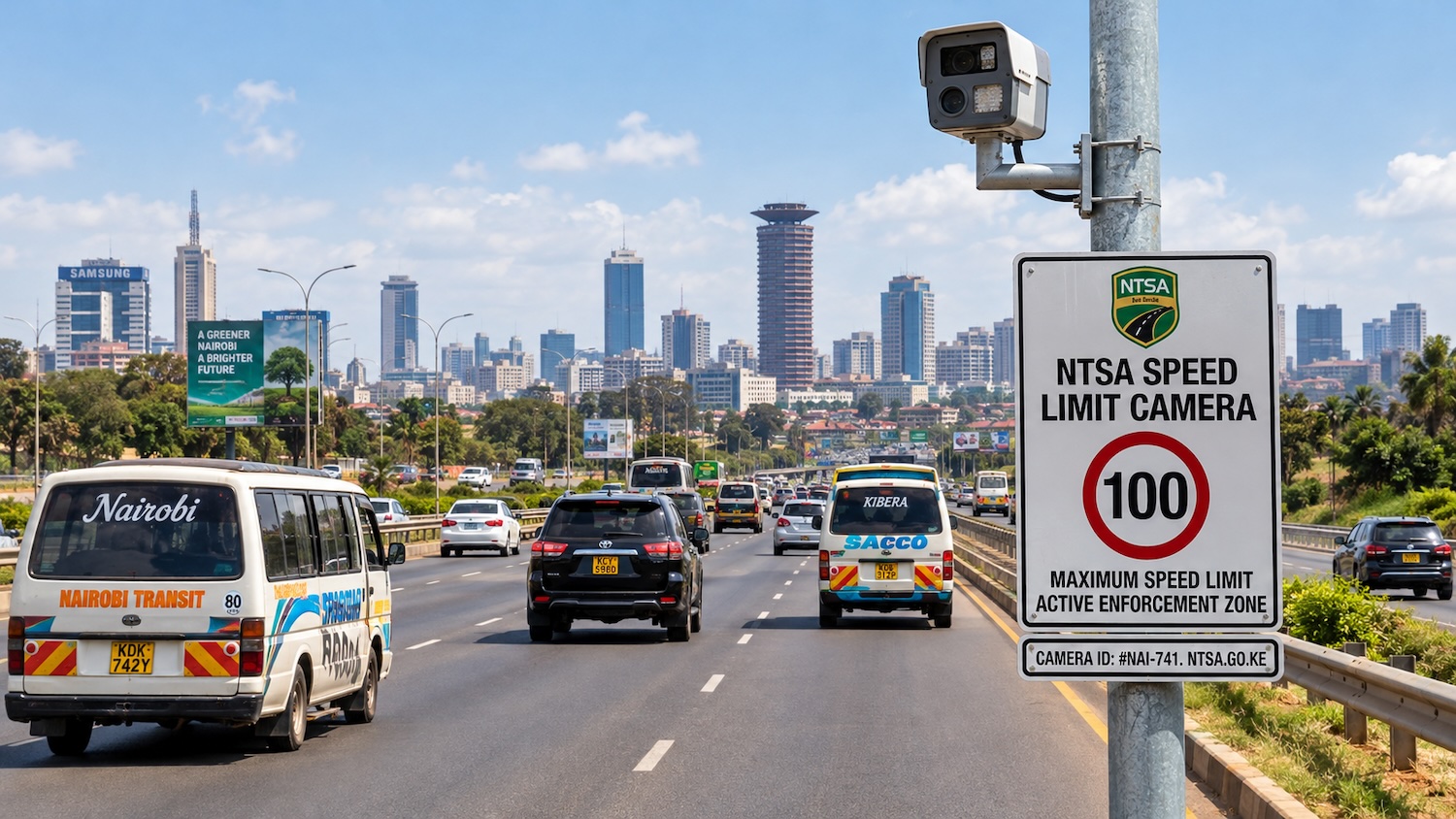
Drive the Nairobi Southern Bypass from Kikuyu to Ole Sereni and count the speed limit signs. Heading toward Nairobi, I find one: a solitary 110 km/h sign just before the virtual weighbridge. Before and after that, the road goes silent. No repeater signs after the Dagoretti, Ngong Road or Lang’ata interchanges, where thousands of drivers join the highway having passed no sign at all. No step-down warnings where the limit is said to change.
Now look at what the public has been told. When the cameras went live, widely circulated lists of camera locations put the weighbridge section and the Ngong Road interchange at 80 km/h. Yet a motorist fined on the same bypass shared his notice, and it cited a posted limit of 110 km/h. So, which is it? The sign says 110. The published lists say 80. The enforcement system says 110, at least on the day it fined that driver.
Into this vacuum steps Waze and Google Maps, pinging contradictory speed zones along the same corridor. Tech blogs now advise Kenyans to let a navigation app tell them the limit. Think about what that means. The law of the Republic is being communicated to its citizens by a crowdsourced app owned by a foreign corporation, because the highway authority has not put up a metal sign.
The stakes of this confusion are not small. Under the instant fines schedule, 6 to 10 km/h over the limit costs KSh 500, 11 to 15 costs KSh 3,000, and 16 to 20 costs KSh 10,000. A driver doing 100 on a stretch she believes is a 110 zone, but which the system treats as 80, has just lost KSh 10,000 for obeying the only sign on the road.
The State Is Breaking Its Own Law
Scandinavia, and particularly Sweden, sets standards on road traffic management globally. But we do not need to fly to Stockholm or Vienna to find the standard Kenya is violating through NTSA. It is in our own Traffic Act.
Section 70(1A) is one sentence long: a highway authority shall cause to be placed on or near a road traffic signs prescribing speed limits on the road. Shall, not may. Section 42 goes further. Wherever the 50 km/h urban limit applies, and wherever a lower limit is imposed on a stretch of road, the highway authority must erect and maintain signs that plainly show drivers where the restriction begins and where it ends.
Let me be precise. A road without signs is not a road without law. The Traffic (Speed Limits) Rules set default maximum speeds for each class of vehicle, and those defaults bind you whether or not anyone has posted them. But that is the whole point. If the Southern Bypass carries a limit lower than the default, or a limit that changes from one section to the next, the Act says the Kenya National Highways Authority (KeNHA) must mark where it starts and where it stops. On urban roads, the same duty falls on the Kenya Urban Roads Authority (KURA).
The courts have already read these sections thoroughly. In a 2023 High Court petition over missing signage around Kedowa, Sobea and Salgaa, the judge set out both provisions and found it clear that erecting the signs is the highway authority’s responsibility. And a decade ago, a speeding charge arising from the Southern Bypass itself came apart in the High Court over the muddle in the Act’s speed provisions. The warning lights have been on for years.
Above the statute sits the Constitution. Article 47 guarantees every person administrative action that is lawful, reasonable and procedurally fair, and the Fair Administrative Action Act gives that guarantee teeth. A penalty generated by a machine, for breaching a limit the responsible authority never posted, is not difficult to measure against that standard.
So, the legal picture is this. One arm of the state, NTSA, is enforcing with cameras. Another arm, KeNHA, is in default of the statutory duty that makes enforcement fair. And we, the wananchi, pays for both.
Follow the Money, Then Follow the Court File
Is this about safety or about revenue? Look at how the system was built and decide for yourself.
The cameras are not a public works project. They are the centerpiece of a KSh 42 billion Public-Private Partnership to deploy 1,000 of them, 700 fixed and 300 mobile, alongside a new smart driving license. The contract with the Pesa Print (pun intended?) consortium runs for 21 years. A private investor does not put up that kind of capital out of love for Kenyan pedestrians. It expects a return, and the public has not been shown how that return is calculated or how much of it rides on the volume of fines. A system whose financing depends on violations has no reason to want fewer violations. This is the question NTSA must answer in public, with the contract on the table.
Then there is the fines collection channel. When the system launched on March 9, NTSA directed that fines be paid through the branch network of one commercial bank, KCB, within seven days, after which interest accrues, and the motorist is locked out of NTSA services. Traffic offences are criminal matters. Since when does a penalty for a criminal offence bypass the Judiciary and land in a designated commercial bank, through personal accounts?
The speed of its implementation tells its own story. On March 2, Ruto told a road safety meeting at State House that rolling out cameras is not rocket science and ordered it done within a month. Seven days later the system was live. Painting lane markings is not rocket science either. Nobody gave KeNHA a one-month deadline for that.
And while we are on KeNHA and KURA, we all know that during the design of these roads, money is allocated for all necessary road furniture and markings by the engineers. We know this because state communications operatives and bloggers are always sharing the beautiful futuristic looking renderings in the buildup to the launch of the projects or when they’re being commissioned. What the happens to the resources allocated for the same?
The courts noticed. On March 12, three days after launch, Justice Bahati Mwamuye issued conservatory orders after a petition by Sheria Mtaani and advocate Shadrack Wambui, restraining NTSA from generating or enforcing penalties through automated decision-making systems. NTSA came back on 1st June under the Minor Offences Rules. On 6th June, Justice Dennis Kizito in Kerugoya suspended the PPP itself after a petition by the Road Safety Association of Kenya, which says the project was rushed through without meaningful public participation.
NTSA’s response has been to insist that instant fines remain in force through existing cameras and police, and that only the expansion is frozen. And the fines have kept on coming. Court orders or no court orders, motorists are still receiving SMS penalties from the cameras. NTSA says the courts allowed it to proceed so long as it keeps payment records. Yet as recently as 30th September 2026, a conservatory order barring automated penalties was reported as still standing. A state agency that punishes citizens for breaking the rules cannot itself treat a judge’s orders as optional. Today a Kenyan driver cannot say with confidence what the speed limit is on the Southern Bypass, or on Thika Road, or many other roads and cannot say with confidence whether the system fining her is lawfully operating. That is not law enforcement. That is confusion with a seven-day payment deadline. That is colonial extraction.
A Camera Warning Is Not a Speed Limit
I’ll give credit where it is due. On 30th September, the NTSA Director-General Nashon Kondiwa announced that every speed camera will now be accompanied by clear signage telling motorists they are entering a monitored zone. The nearly seven months of public anger and two court orders have finally produced a concession that should have been the starting point. Community organizing works. Litigation works. Let us all remember that, especially while in this plantation.
But we must read his promise very carefully. A sign that says a camera is ahead only tells me that I am being watched. It does not tell me what the limit is, where it began, or where it ends. Those are the signs sections 42 and 70 of the Traffic Act demand, and they are KeNHA’s duty, not NTSA’s. Nothing announced on 30th September commits KeNHA to a single repeater sign on the Southern Bypass or Thika Road or any other highway.
The pledge also concedes the deeper point. If the purpose of a camera is to make people slow down, a visible camera does that at the moment of danger. In the UK, fixed cameras are painted bright yellow for exactly this reason. A camera nobody can see slows nobody down on the day. It sends a bill afterward. Public participation in planning and deciding how road safety measures are implemented and enforced is crucial in getting societal buyin.
I will not overstate this. The research is clear that speed cameras, including covert ones, reduce crashes and deaths over time, because drivers who expect to be caught anywhere slow down everywhere. Cameras are not the enemy. But that deterrent effect depends on drivers knowing the limit they are being held to. Deterrence without a posted limit is not deterrence. It is playing karata with Kenyans lives. Pata potea.
Whose Safety? Start With the People on Foot
Now I must turn the argument on my own class. Those of us who drive private cars are a minority of Kenyans and a minority of the dead. The typical victim of a Kenyan road is a pedestrian crossing a highway that was built through her neighborhood without walkways, without a footbridge or underpass, or a boda boda rider on an unlit stretch with no shoulder. Speed is what kills them. If this debate becomes motorists complaining about fines, we will have missed the people the cameras claim to protect.
So “infrastructure before enforcement” cannot only mean signs for drivers. It must mean what the Safe System approach has meant since Sweden adopted Vision Zero in 1997. That approach begins from a humble premise: human beings make mistakes, so the road must be designed so that mistakes are not fatal. Responsibility shifts from the individual road user to the system designers, the engineers, planners and authorities who decide what the road looks like.
In practice that means a median barrier, so a drifting vehicle does not become a head-on collision. It means a safe crossing wherever people actually cross, not a kilometer away where it was cheaper to build. It means lighting, walkways, lane markings that reflect at night, and road geometry that slows vehicles near markets and schools without asking anyone’s permission. When someone dies, a Safe System authority asks why the road allowed that mistake to be fatal, and then it fixes the road.
Kenya and NTSA have inverted this. A highway can go years without markings, lights or guardrails, and no official pays a shilling or spends a night in a cell. No engineer receives an SMS. No Director-General is locked out of a government portal. But let a mwananchi misjudge an unposted limit on that same road, and the state discovers artificial intelligence. The technology exists to hold the citizen accountable. It has simply never been pointed at the state.
This is the oldest pattern in our public life. Kenya’s colonial state built roads to extract and policed Africans for using them wrongly. The pattern survives wherever a government treats wananchi as a source of revenue first and as people second.
Utu and the Social Contract
Utu is not softness. It is a demanding standard of mutual obligation. If mtu ni watu, then the state, which ideally is only us as watu organized, owes each of us the conditions under which we can do right by one another. With dignity.
On the road, that obligation runs in both directions. My duty as a driver is to slow down, because the child crossing ahead of me is someone’s whole world and her life is worth more than my arrival time. Utu asks that of me whether or not a camera is watching. I accept that duty, and so should every driver reading this.
The state’s duty is to make the law visible, the road forgiving, and the penalty fair. Post the limit. Paint the lines. Build the crossing. Give the accused a hearing before a human being. A government that demands compliance while withholding the means of compliance is not governing. It is harvesting in the plantation. It is extracting.
Utu also tells us what enforcement is for. A fine is supposed to be a correction between people who share a road and a future. When it is issued by an algorithm, collected by a bank through a personal account, financed by an investor and contested only by those who can afford a lawyer, it stops being correction. The citizen stops being a partner in road safety and becomes a recurring revenue line. That is the breach of the social contract, and no amount of technology can launder it.
Infrastructure First: What We Must Demand
Outrage on social media got us a signage pledge. Organized demands can get us a safe system. Here is what to ask for, and whom to ask.
- KeNHA and KURA: comply with the Traffic Act before any camera issues a fine. Speed limit signs at the start and end of every zone, repeaters after every interchange, step-down warnings before every reduction, and reflective lane markings on every camera corridor. Start with the Southern Bypass and Thika Road and publish the completion date.
- NTSA: publish the map. One official, gazetted schedule of the speed limit on every monitored section, so that no Kenyan depends on Waze or a blog to know the law.
- The Cabinet Secretary for Roads and Transport: put the contract on the table. Release the full PPP agreement, including how the private partner is paid and whether its return depends on the number of fines issued.
- Parliament: ring-fence the money. Every shilling collected from traffic fines should go to a public fund for footbridges, crossings, lighting and signage on the corridors where people are dying, with annual public accounts.
- NTSA and the Judiciary: guarantee a human hearing. No penalty should become final, and no citizen should be locked out of public services, before a simple, free and accessible way to contest the fine before a person.
- Audit the system designers. For every fatal crash on a national highway, a published review of what the road contributed, and a named authority responsible for fixing it.
To fellow citizens, community organizers and civic leaders: this is winnable, and the courts have already shown it. Walk your stretch of road. Photograph every missing sign, faded line, dark crossing and pothole. File Article 35 access to information requests with KeNHA, KURA and NTSA for the signage audits and the contract. Take the evidence to your county assembly, your MP and if possible, enjoin the petitions already before the High Court.
And to every driver: punguza mwendo. Slow down, not because a lens in the bush might be watching, but because the person on the roadside is your neighbour, or relative.
We the citizens will keep our side of the contract. It is time the state kept its own. Barabara zetu, maisha yetu, jukumu letu sote.
Utu Na Uzalendo.
Follow This Is Africa on Twitter and Facebook to join the conversation.
You may like


Maputo to Host 2026 All-African Movement Assembly for Activists & Human Rights Defenders


The passport, the database and the State: Who controls digital Zimbabwe?


When the Algorithm decides what we see: Who governs Africa’s digital democracy?


Education is neither a commercial venture nor a credit facility but a basic need and a public good


The third global wave of autocratization One playbook, two instruments: Legal façades and structural decay in the world, with Indonesia and Kenya as case studies


The great ledger correction: Why cancelling the debt of the Global South is restitution, not forgiveness