
Politics and Society
“The people shall govern”
Adopted 60 years ago this week, the Freedom Charter is a seminal document in South Africa’s political development, yet 21 years after liberation, the brawl for the ‘country’s wealth’ risks trampling its ideals into the ground

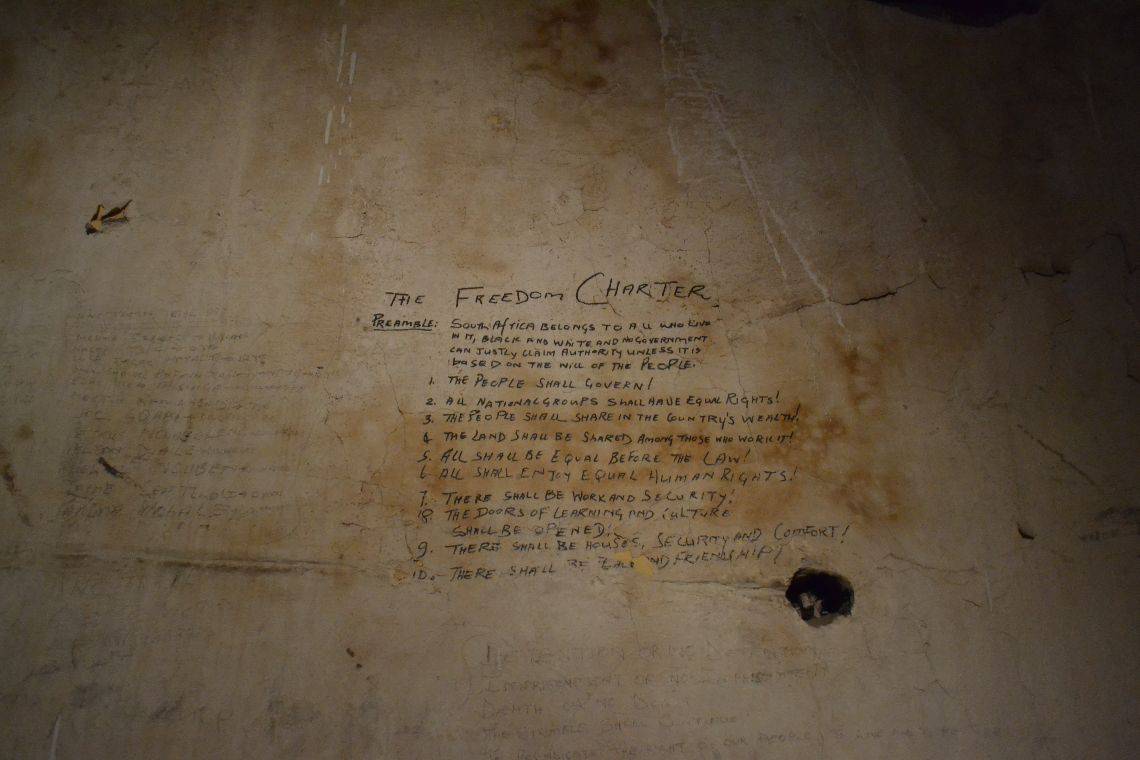
On the 60th anniversary of South Africa’s Freedom Charter, reflections on the Kliptown Charter were given heightened significance as they coincided with the release of the Farlam commission report into the massacre by police of striking platinum miners at Marikana in 2012.
Nevermind the Charter’s call that, “the mineral wealth beneath the soil … shall be transferred to the ownership of the people as a whole”, even a decent wage is being resisted by the nexus of political and economic power now fleecing the country.

Mambush Noki and Xolani Ndzuzu speak to the police, with striking Lonmin miners behind them at Marikana. Image: Greg Marinovich, The Stand
In the name of the Freedom Charter, political parties, including the ANC, jostle to bolster their image; others use it as a weapon against the ruling economic system and to legitimize their policies; some even use it to atttack the Constitution; meanwhile, the press is bursting with columnists cogitating on how far South Africa has come or how short it has fallen from the benchmark of the Charter.
That the Freedom Charter is still felt to be relevant is indisputable and it will be so until there is greater economic equality in the country. A document developed by 50,000 volunteers from all walks of life fanning out across the country and the pivotal role it played as a rallying cry in the long struggle against apartheid means the Charter continues to resonate on an emotional level in a way that the Constitution has not yet quite achieved.
But it is necessary to first see the Charter in its historical context, as a document of its time. For instance, it talks about the rights of “national groups,”, apartheid language for race that seeped into the document because of its era. It also talks about “the peasants”, language that is today seen by many as offensive.

“Remember Marikana” by Tokolos Stencil. Image: Delwyn Verasamy, Mail & Guardian
The Freedom Charter does not actually call for the wholesale exproriation of all land, as many believe it does. However, its framers clearly understood it to call for the nationalisation of all banks, monopoly [big] industry and the mines, which 60 years later in today’s global economy is unachievable.
There is a tendency by some to treat the Freedom Charter as some kind of a report card or “to do” list against which we can tick off where we pass and where we fail – as if we would live happily ever after once we have nationalised the banks and redivided farmland among the farm labourers that work it.
Care really needs to be given to the spirit of the Charter and the type of world it envisioned, rather than to its letter. Most of the ideals of the Charter were realised in law – on paper at least – with the advent of the South African Constitution. There is a direct line between the fact that we have socioeconomic rights enshrined in the Constitution and the Freedom Charter. Why then is the nation stumbling to liberate its people economically?
The essence of both our Constitution and the Freedom Charter is this: “the people shall govern”. The people – not the “ruling” party, not the presidency, not the old and new plutocratic elite.

The People Shall Govern. Image: Live SA
With “the people shall govern”, the Freedom Charter implies a truly participatory democracy. This requires the separation of power of the three branches of government – legislative, executive and judicial. It requires accountable democratic representation at local and national level. It necessitates genuine public consultative processes and a functioning autonomous parliament. It entails strong independent institutions and regulatory bodies – from the Independent Communications Authority of South Africa (ICASA) all the way to the National Prosecuting Authority. It demands a free press – “the law shall guarantee to all their right to speak”. Creating a more equal and fairer society depends upon these mechanisms. The people cannot govern merely through party representation.
Staring down the barrels of real guns and in the face of the brute forces of a draconian state, the people at Kliptown did not wait for their freedom, but seized it and declared it for “all the world to know”. Today, we have an ongoing battle to maintain those freedoms as they are whittled away or brushed aside by the rotten stewards of our democracy. Keeping a participatory democracy alive is a labour with no endpoint. Freedom is never finished. Our only chance of a more equitable society – as envisioned by both the Constitution and the Freedom Charter – is if the people truly govern.


