
African identities
Femi Longe and the architecture of African liberation
The radical Pan-African vision of Lumumba, Sankara, and Nkrumah is being resurrected through financial technology. Spearheaded by Femi Longe at the Human Rights Foundation, the Bitcoin Development Fund is systematically resourcing African developers to dismantle colonial monetary systems like the CFA franc. This decentralized economic resistance is continuing the unfinished struggle for absolute continental sovereignty.

The continent has not forgotten what it lost when Patrice Lumumba was murdered in a Katanga forest in January 1961. It has not forgotten what Thomas Sankara did in four short years in Burkina Faso before his own assassination in October 1987. It has not forgotten the architecture Kwame Nkrumah was trying to build when the 1966 coup ended his presidency and his Pan-African project together. These three names are not nostalgia. They are an unfinished argument. They mark the political possibility that imperial financial-military power decided Africa was not allowed to have.
The CFA franc still ties fifteen African countries to a monetary system designed in Paris.
The argument is unfinished because the structures that arrayed themselves against Lumumba, Sankara, and Nkrumah are still operating today. The CFA franc still ties fifteen African countries to a monetary system designed in Paris. The Bretton Woods institutions still deliver their conditionalities to African finance ministers like sealed envelopes from a colonial governor. SWIFT still functions as the financial perimeter inside which African economies are permitted to operate and outside which they are punished. The architecture is intact. What has changed is that, for the first time since independence, there exists a technology and a political constituency capable of beginning to dismantle it from below.
That is the context in which Femi Longe is doing his work.
The Lineage and the Lift
Femi Longe currently serves as the Global Freedom Tech Strategy Lead at the Human Rights Foundation, where he runs the Bitcoin Development Fund. He works alongside Alex Gladstein, HRF’s Chief Strategy Officer and one of the architects of the Foundation’s decade-long thesis that financial freedom is the precondition for political freedom. Together, they have built the most consequential global infrastructure for resourcing Bitcoin freedom tech in places where states use financial systems as instruments of repression. The job description is administrative. The work is not.

Femi Longe currently serves as the Global Freedom Tech Strategy Lead at the Human Rights Foundation, where he runs the Bitcoin Development Fund.
What Femi is actually doing, every quarter, in every grant decision, in every conference appearance, in every conversation with a developer in Lagos, a circular economy builder in Maputo-Matola, or a women’s coding collective in Dar es Salaam, is reconstructing the political infrastructure that Lumumba, Sankara, and Nkrumah were assassinated and coup’d out of building.
Africa’s economic liberation remains intentionally suppressed by predatory global financial architectures. Now, grassroots tech movements are equipping African innovators to dismantle these colonial structures from below.
He says it in his own voice every time he speaks. Passionately. Privately and publicly, in panels and in side conversations, the message is the same: Africa’s final liberation has been deliberately deferred by financial structures designed to hold the continent to ransom, and the innovation that would otherwise pour out of African builders has been intentionally stifled by an architecture that profits from its suppression. It is a Sankara analysis. It names the structures rather than the symptoms. And like Sankara, Femi pairs it with a constructive program: get resources, real resources, into the hands of the African builders who are already constructing the alternative.
What the Grants Show
In January 2026, the Bitcoin Development Fund announced 1.3 billion sats deployed across 22 projects worldwide. In April 2026, it announced another 1.5 billion sats across 26 projects. Cumulatively, BDF has now deployed $11.8 million to 367 projects across 68 countries since 2020. A glance at the two most recent rounds tells you everything about what has happened to the Fund’s African footprint under Femi’s stewardship.

Trader holding a CFA Franc note.
From the April 2026 round: Banxaas, building CFA franc to Bitcoin rails out of West Africa under founder Nourou. ChapSmart, integrating Lightning with M-Pesa from Tanzania. Tando, building Bitcoin payments over M-PESA in Kenya, co-founded by Sabina Waithira Gitau. Tapnob, working across the continent. Bitcoin Benin, running the Knowledge Hub and preparing Bitcoin Mastermind 2026 in a CFA-franc country where the political stakes of monetary education are unusually high. BTC Shule, running an eight-month accelerator out of Burundi. Daniel Batten, doing research grounded in the realities of Nigeria, Ethiopia, and Egypt.
From the January 2026 round: Bitcoin Famba in Maputo-Matola, Mozambique. Devgitotox, a Tanzanian woman contributing directly to Bitcoin Core. The Africa Free Routing Lightning Developer Bootcamp, training developers across Ethiopia, Uganda, and Burkina Faso with plans for ten bootcamps. Bitika, in Kenya, building Lightning self-custody from M-Pesa.
Eleven African projects in two consecutive quarters. The geographic spread is deliberate. The structural targets are specific. CFA franc countries are receiving disproportionate attention, which is what you would expect from a strategist who understands that the franc is the most acute monetary expression of unfinished decolonization. M-Pesa integration is being resourced in three separate projects, which is what you would expect from a strategist who understands that the continent’s existing payment rails must be made interoperable with Bitcoin or the technology remains marginal. African women contributing to Bitcoin Core itself, not just using it but building it, are being directly funded, which is what you would expect from a strategist who reads the politics of who builds as inseparable from the politics of what gets built.
This is not random. This is a Pan-African resource allocation strategy executed with discipline.
Mentor, Thought Leader, Freedom Fighter
The mentoring work is not visible in press releases. It is visible in the trajectories of the people Femi has resourced and counselled over the years. African builders who would otherwise be raising venture rounds in Silicon Valley on terms that would gradually strip them of mission alignment have, in Femi, a counsellor who tells them that there is another way. That HRF money does not come with extractive equity terms. That a circular economy in Maputo-Matola or a Lightning bootcamp in Burkina Faso is a legitimate end in itself, not a stepping stone to a Western exit. That building for African users, in African contexts, addressing African structural problems, is the work. He tells them this in private, and the work shows up in their grant proposals.
The thought leadership is visible in the framing he brings to every public conversation. Where most Bitcoin advocates lapse into the Western libertarian register of state coercion versus individual sovereignty, Femi speaks the language of continental political economy. The structures, named. The colonial inheritance, named. The deliberate suppression of African innovation, named. Bitcoin not as gold replacement or speculation vehicle but as one specific tool inside a broader Pan-African project of building the institutions and infrastructure that the post-independence generation was murdered or coup’d out of building.

Lumumba salutes the photographers as he leaves the Idlewild airport 02 August 1960, to go to his hotel in New York. Leader of the Congolese national movement, he became the first Prime Minister (1960) of the new state Democratic Republic of the Congo, former Belgian Congo, renamed Zaïre in 1971. Photo: ANP
The freedom fighter dimension is the hardest to talk about publicly, but it is what makes the entire project coherent. To do what Femi does, in the institutional position he occupies, requires an analysis sharp enough to identify what to attack and a discipline cool enough to attack it through the slow, undramatic work of grant decisions and capacity building rather than through theatrics. Sankara understood this discipline. So did Nkrumah at his best. Lumumba never got the chance to demonstrate it at scale because they killed him first. Femi, working in 2026 from a global institutional platform, with allies across the African Bitcoin movement ecosystem and protective scaffolding around him that Lumumba did not have, is doing what they were trying to do.
The Continental Moment
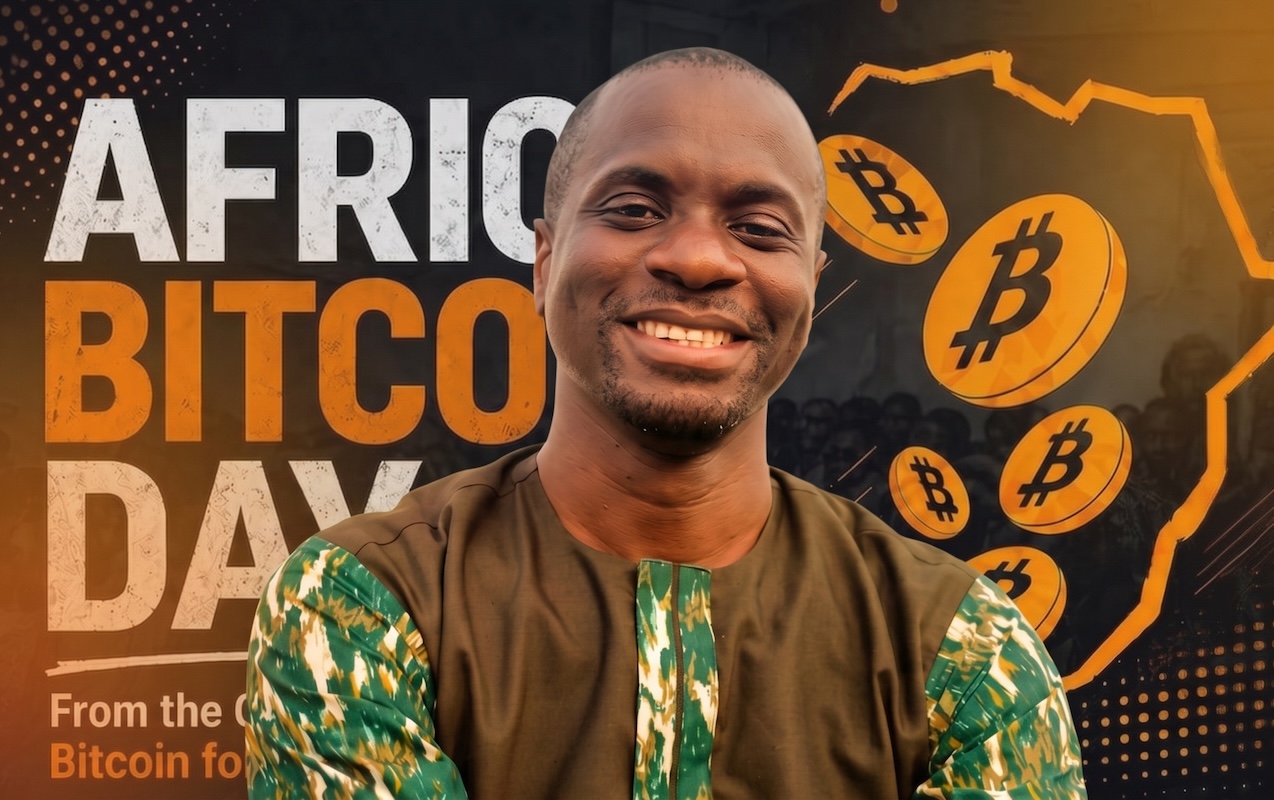
The Africa Bitcoin Day cluster running across eight cities in late May 2026 is not coincidence. It is the visible surface of a movement that has been built deliberately by people such as Farida Nabourema, Nourou, the team at Bitcoin Dada, the Bitika and Tando builders in Nairobi, the Bitcoin Famba community in Mozambique, the Bitcoin Loxion organisers in Khayelitsha, the BTC Shule team in Burundi, and dozens more. Many of them have been resourced, mentored, or amplified by Femi at various points in their journey. The Africa Bitcoin Conference, where Femi has given keynotes, hosted sessions and appeared in Fireside Chats with figures like Lightning Labs co-founder Elizabeth Stark, is the public theatre. The grants, the mentorship, the strategic patience are the underlying work.
Africa is not waiting to be liberated. It is liberating itself, one circular economy at a time, one developer bootcamp at a time, one CFA franc off-ramp at a time. Femi Longe is one of the architects of that liberation, working from inside an institution that has chosen to fund it rather than to obstruct it.
Lumumba would have recognized him. Sankara would have shaken his hand. Nkrumah would have welcomed him to the table he was building before they took it from him.
The lineage is not broken. It is being continued.
Follow This Is Africa on Twitter and Facebook to join the conversation.


