
Politics and Society
Finding the African way | The time for putting ourselves first
Imported Western aid models are failing across Africa because they ignore existing, durable local systems. While costly, six-month donor programs distribute livestock only for projects to collapse upon completion, indigenous “table banking” groups thrive. True African economic modernity isn’t found in foreign-backed infrastructure or elusive billionaires, but in cooperative, distributed networks built on community trust and ubuntu.

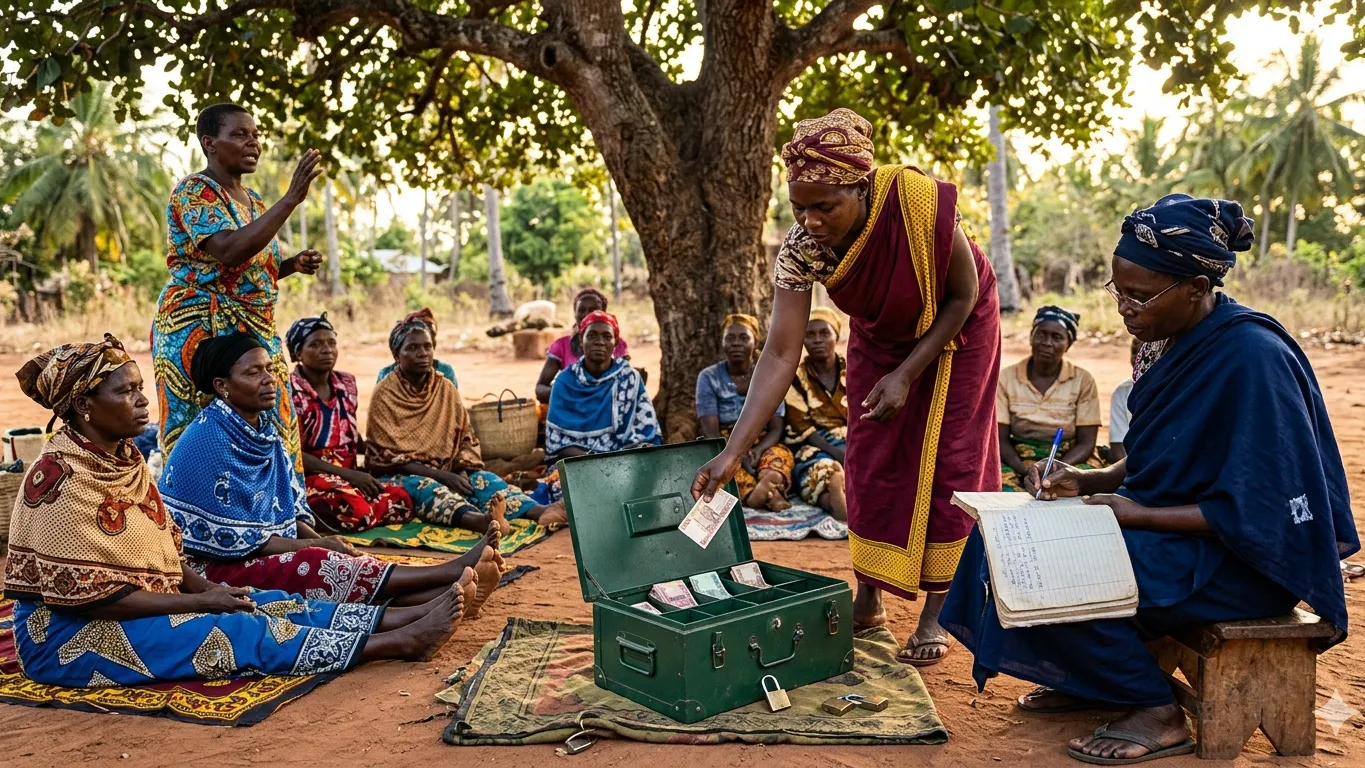
In 2021, I spent some months visiting women’s table banking groups in Kilifi and Kwale counties, on the Kenyan coast. Nine hundred women in total, across many groups. I would arrive at the meeting place, usually under a particular tree the group had claimed as its own, and I would sit on the sidelines while the women did their work.
The shape of the meeting was always the same. Each woman brought her weekly savings. The secretary recorded each contribution in an exercise book — the same kind of exercise book children use at school, the cover bent, the pages filled with careful handwriting. The money went into a metal box. The box was kept by one woman. The key to the padlock was held by another. The separation was deliberate. No single person could open the box.
Then the lending happened. A woman who needed money would make her case. The group would discuss it. They would decide. The loan would come out of the same box that had just been locked. Interest rates were agreed in the room and held to. Defaults were rare, and when they did occur, the social consequences within the group did more work than any formal collection process ever could.
At the end of the year, they would break the box. The phrase is theirs. Everyone would arrive in matching deras or kitenges, dressed for the occasion. The accumulated savings, with the interest the lending had generated, were shared out in proportion to each woman’s contribution. Each woman would take her share and spend it on the thing she had been working toward all year. A new roof. A full year’s school fees for her children. A small piece of land. A capital injection into her own little business. The investment was substantial, deliberate, and entirely hers.
I watched this same pattern unfold across nine hundred women. It was unfailing.
In the same period, in the same counties, sometimes with overlapping membership, another set of activities was taking place. Development organisations were running programmes to bring “income-generating activities” to the same women. They would arrive, distribute goats or chickens, set up a common farming plot, train the women in the rudiments of small business, and run the programme for six months. At the end of the six months, the organisation would close the programme, write up the success — every woman has a goat, every woman has been trained, the farm is green and producing — and move on to the next intervention.
A week or two after the organisation left, you could go back and find that the goats had been sold, the chickens slaughtered or sold, and the farm sitting unused. The women had taken what was given and converted it into something they could use, on their own terms, through the channels they already had. The metal box, you might say, was waiting.
A Tale of Two Systems
I have been thinking about this contrast for several years now. The two systems were operating in the same villages at the same time. One of them has been running for as long as anyone in the village can remember. The other had a six-month timeline and a closing ceremony. One system did not need to be supported, defended, or explained — it simply continued, because it was built on a logic that fit the women’s lives. The other needed to be brought in from outside, propped up with donor money, monitored for compliance, and reported on for the benefit of audiences that lived very far away. As soon as the propping stopped, the second system stopped.
I do not think this is a story about the two counties on the Kenyan coast. I think it is the story of what has happened across most of this continent for the better part of a century.
Colonialism, when it arrived, found systems already in place — for moving wealth, for resolving disputes, for organising land, for governing communities, for transmitting knowledge across generations.
It overlaid imported alternatives on top of those systems and called the imports the formal layer of African life. The original systems were pushed underground, renamed informal or traditional, and treated as residues that modernity would clean up in due course. This was the colonial wager. It has been carried forward by the development sector to the present day, in projects very like the goats-and-chickens programmes in Kilifi.
The wager has not paid off. The formal layer that was supposed to do the work has, in domain after domain, failed to do it. The hospitals that were supposed to deliver universal care depend on donor funding that can be turned off at the whim of a foreign administration. The universities produce graduates whose training fits no labour market that exists here. The constitutional frameworks have delivered election cycles but rarely the stable, accountable governance they were supposed to produce.
Look most closely at agriculture, because the failure is most visible there. The formal system has it that, to make real money, the African farmer should export raw produce to Europe, using standards the Europeans define, within the quotas the multilateral trade agreements allow. Local products have been positioned as lower-quality than imported ones, within a hierarchy that places European goods first, Asian goods second, and African goods last. Some of this is branding and packaging. Most of it is narrative, cost structure, and distribution networks. The African consumer has been socialised across generations to reach for imported tin and look past what the farmer down the road has grown.
So the African farmer grows for export. She tears out the food crops her grandmother kept and plants what the European buyer wants. She organises her year, her labour, her family budget, her debts around the next shipment to Rotterdam or Hamburg. And then the European buyer stops coming.
In Kilifi, when the foreign investor stopped buying cashew nuts from the mega factory, the farmers cut down their cashew trees and sold them for charcoal and timber. The trees had taken years to mature. They were gone in the afternoon. The farms now sit bare. In Kiambu, when tea and coffee stopped being profitable, the farmers tore out the bushes and built rental apartment blocks on some of the most fertile red soil in East Africa. The soil that fed a country for a century is now under concrete. These are not the worst stories. They are simply the ones nearest to where I live.


The cashew farmer in Kilifi is in a worse position than the women under the tree. The women always had the metal box. The cashew farmer was brought fully inside the imported system, organised her life around it, and now has nothing underneath when the system turns away. The African food economy that her grandmother knew how to operate has been suppressed for so long that she cannot quickly switch back to it. The narrative trapped the trees. The trees became charcoal.
Beneath the formal layer that keeps breaking down, the other system continues operating where it has been allowed to. Quietly. Without much help. With remarkable durability. The metal box, the exercise book, the key held by a different woman, multiplied across the continent in forms whose details vary but whose underlying logic does not.
Most Africans live in both systems at once, and we have learned not to mention the fact in the rooms where serious decisions are made. We register our businesses with the Companies Office, and we run them on relationships the Companies Office cannot see. We bank with KCB, and we belong to a chama. We use M-Pesa, and we keep the metal box. The double life is the actual texture of African modernity. It is not a transitional condition. It is the condition itself.
The trouble is that only one of the two systems has been allowed to count. The formal system gets the budgets, the buildings, the policy attention, and the international recognition. The other gets called informal, traditional, or anomalous. But the vocabulary is wrong. What we have been calling informal is the actual working economy of most African societies. What we have been calling traditional is the actual working modernity of how Africans live. The categories that made these systems invisible to us came from elsewhere, designed to describe a different kind of society, and we have spent a hundred years trying to make our reality match the categories rather than the other way round.
The Question of Scale
There is a particular foreign argument I want to take on directly because it lies beneath everything else, and until we name it, we cannot move past it. The argument is that scale is the source of profitability. For a business to succeed, it must grow, dominate its market, and capture the value across the chain. We have absorbed this argument so thoroughly that we now design our economic policy around it. We measure progress by the size of the firms we produce. We treat the absence of African billionaires as a sign of our failure rather than as a sign that we have organised ourselves differently.
But look at where that logic has led, in the societies that have followed it most rigorously. A handful of billionaires. Millions of poor. Inequality that is now politically destabilising the countries that pioneered the model. The scale argument has not been a description of how economies work. It has been a particular kind of economic life, optimised for a particular kind of outcome, exported as a universal truth.
I think the African scale is different. The African scale is characterised by many small enterprises, owned by many people, employing many more people, and distributing wealth widely rather than concentrating it narrowly. The chama is an African scale. The cross-border trader moving goods between Busia and Kampala is on an African scale. The aloe vera producer in coastal Kenya is African scale. None of these will produce a billionaire. All of them will produce hundreds of thousands of people, operating at scale. That is not a less ambitious economy. It is a different kind of ambition, organised around a different question: not who can become the largest, but how many of us can become well.
Ubuntu = I am because we are.
The Work of Finding The African Way
This is the work of finding the African way. It is not to fix the formal layer again. It is to lean fully into the systems we already have, build the institutional architecture that lets them operate at the scale they actually want — distributed, cooperative, ubuntu-rooted — and stop apologising for the fact that they do not look like what someone else built somewhere else.
The change of posture is what matters. We stop trying to bring the women under the tree into the formal financial system and start asking how the table banking logic can be made the foundation of a financial system that the African majority actually uses. We stop forcing the traders who move goods between Kenya and Uganda, Nigeria and Niger, and South Africa and Mozambique to operate as smugglers, carrying their merchandise in the boots of long-distance buses, and start creating the regimes that let them move freely. We formalise the one-sky policy that the African Union has been promising for thirty years, so that a flight from Nairobi to Dakar costs what it should cost rather than three times what it costs to fly to London. We build bilateral arrangements that enable a group of cashew farmers in Kilifi to brand their nuts and sell them in Banjul. We back the aloe vera producers in coastal Kenya to make soap and sell it in Brazzaville and Conakry.
This is not a rejection of foreign direct investment. The continent will continue to welcome serious capital that arrives on serious terms. But we stop organising our economies around the assumption that the mega-investor from elsewhere is what will employ our people and grow our wealth. The evidence of the last century is in. The mega-investor cannot do this at the required scale and cannot be relied upon when conditions shift. Cottage industries can. Many small producers, working together, processing the natural resources this continent has in abundance, and moving goods across borders that should never have existed in the first place — this is what an African economy that fits African societies actually looks like. The policy work is to create the markets and regulatory environments that enable them to thrive. The intellectual work is to stop treating them as a stage on the way to something more sophisticated, and start treating them as the thing itself.
Why The Time Is Now
The window is open now in a way it has not been open for most of our lives. The arrangement that imposed the imported categories is coming apart. The Americans, the Europeans, the French in the Sahel, the multilateral institutions and the consultancy class that lived on their grants — all are preoccupied, weakened, or in retreat. Either we use the moment to build institutional architecture that fits how our societies actually work, or the next reorganisation of the global order will arrive with new categories from elsewhere, and we will spend the rest of this century trying to make them fit, too.
It is time, in the simplest possible language, to put ourselves first. Not against the rest of the world. Not in retreat from it. But in the recognition that for sixty years our economic life has been organised around someone else’s first interest, and that the cost of that arrangement is visible in the cashew trees that became charcoal, in the coffee bushes that became rental flats, in the goats that were sold a week after the development programme closed, in the brittle formal layer that breaks the moment external support is withdrawn.
The women in Kilifi are still meeting under the tree. The box will be locked next week, and the week after, and the week after that. The cashew farmers down the road are still selling their trees as charcoal. The question for the rest of us is which of the two scenes we choose to build from.
This article was first published by Al Kags on AL’S SUBSTACK and it is published here with permission of the writer.
Follow This Is Africa on Twitter and Facebook to join the conversation.


