
Politics and Society
Evidence, inference and democratic legitimacy: Reading the Global Witness report on Zambia
Weeks before Zambia’s election, a Global Witness report alleges mining-sector influence over government policy—but explicitly concedes it found no evidence of corruption or illegality. This critique argues the report’s conclusions outstrip its evidence, raising broader questions about methodology, electoral timing, and the evidentiary standards required for claims of institutional capture.

With only three weeks remaining before Zambia’s general election, Global Witness has published a 36-page report alleging that First Quantum Minerals exercised undue influence over the Hichilema administration’s mining policies. Framed as an exposé, the report advances the argument that the administration’s mining policies reflect undue corporate influence rather than independent public policy-making. Given both the seriousness of these claims and the proximity of their publication to polling day, the report deserves careful scrutiny—not only of its conclusions, but also of its evidentiary foundations and analytical assumptions.
Zambians should read it. They should read all of it—including the sentences Global Witness itself was careful to include, which the headlines will not carry.
The issue is not whether governments should be scrutinised—they should. Nor is it whether mining policy deserves robust public debate—it does. Democracies are strengthened when public institutions, elected leaders and corporate actors are subjected to rigorous scrutiny. The real question is whether the evidence presented is sufficient to support the conclusions drawn. It is against that standard of evidence, rather than political preference, that this report should be assessed.
“Democracy demands rigorous scrutiny, but damning political claims require rock-solid evidence—not mere headline allegations.”
This article is not concerned with defending or condemning the Hichilema administration. Its purpose is to examine whether the evidentiary standard presented in the report is proportionate to the seriousness of the conclusions advanced.
Here is what the report actually says, in its own words. Global Witness “has no evidence to suggest and does not allege that FQM has been involved in corruption.” It “does not allege” that the financial support it describes “breaches Zambian domestic electoral or political donation laws, or is otherwise illegal.” It has “no evidence to suggest that FQM knew” what any funding would be used for. It found “no evidence of FQM directly funding” the social media pages it complains of. It concedes that evaluating whether mining investment would have happened without fiscal reform “is difficult and not in the scope of our analysis.”
Once those caveats are taken into account, an important question remains: what evidentiary basis supports the report’s central conclusions? The result is a report that alleges no crime, identifies no illegality, and cannot establish its own central causal claim, yet was published at a politically consequential moment.
We do not write as reflexive critics of Global Witness. We have cited its investigations on Zimbabwe for years, particularly its work on the Marange diamond fields, which combined documentary evidence, corporate records and financial tracing with exemplary rigour. That history makes the Zambia report all the more striking. An organisation known for following documentary evidence has, in this instance, produced a case that relies predominantly on anonymous testimony. Readers are entitled to ask whether the available evidence supports the weight of the conclusions reached.
Consider next how the report constructs its central argument. The report rests on “dozens” of interviews, almost all anonymous: former employees, unnamed officials, and opposition politicians — the latter being political actors whose immediate political objective during an election campaign is to persuade voters to support an alternative government. Anonymity is sometimes necessary and journalism could not function without it. But a claim that cannot be tested is a claim that must be taken on faith, and readers are therefore being asked to place considerable weight on claims that cannot readily be independently verified. The most explosive figure in the report —an alleged fifty-million-dollar pledge – traces to a single unnamed former employee recalling what the company is said to have said. No document. No date. No name. The company denies it categorically and asks, reasonably, how such sums could move through independently audited accounts unnoticed. That question deserves an answer the report does not supply.
Then there is the argument at the report’s heart, which rests on an analytical assumption that merits closer examination: it appears to conflate the implementation of an electoral mandate with evidence of institutional capture. Hakainde Hichilema has consistently campaigned on a pro-mining platform for two decades. He contested five elections saying exactly what he would do: restore investor confidence, stabilise the fiscal regime, and grow production so that Zambia earns its way out of debt rather than taxing a shrinking industry into the ground. He said it on radio, in manifestos, at rallies in Solwezi and Kitwe. Zambians heard him and elected him – by a landslide, over an incumbent whose government had detained mining executives and watched investment flee. Whether one agrees with that policy platform is beside the point. The analytical question is whether implementing a publicly articulated electoral programme, without more, can reasonably be taken as evidence of institutional capture. When an elected government implements the platform on which it sought and obtained a democratic mandate, this does not, in itself, constitute evidence of institutional capture. To explain Zambia’s mining policy, no secret meetings are required; a manifesto and 2.8 million voters suffice.
If the report questions the rationale behind these policy choices, it is equally important to examine their outcomes. Public policy should ultimately be assessed not only by the motivations attributed to decision-makers, but also by the measurable consequences of those decisions. FQM’s economic footprint grew thirty percent last year to US$3.46 billion. It paid US$902 million to government – up thirty-nine percent in a single year. It spent US$2.14 billion procuring from Zambian-registered businesses, roughly seven percent of our entire GDP. At least six major new mining investments have been announced since the fiscal reforms. These outcomes should be weighed against the estimated US$771 million in foregone mining royalty incentives between 2022 and 2025, together with broader mining-sector tax concessions exceeding US$1 billion that were intended to stimulate investment and production. The ultimate assessment of these trade-offs belongs neither to the authors of this article nor to Global Witness, but to the Zambian electorate acting through democratic processes.
More broadly, Zambia —the first African country to default during the pandemic—has restructured its debt and returned to economic growth. One may call forgone tax under a hypothetical old regime a “loss” – but only by assuming the old regime would have produced the same investment, the same expansion and the same jobs. The report admits it cannot show that. The experience under the previous fiscal regime provides reason to question that assumption.

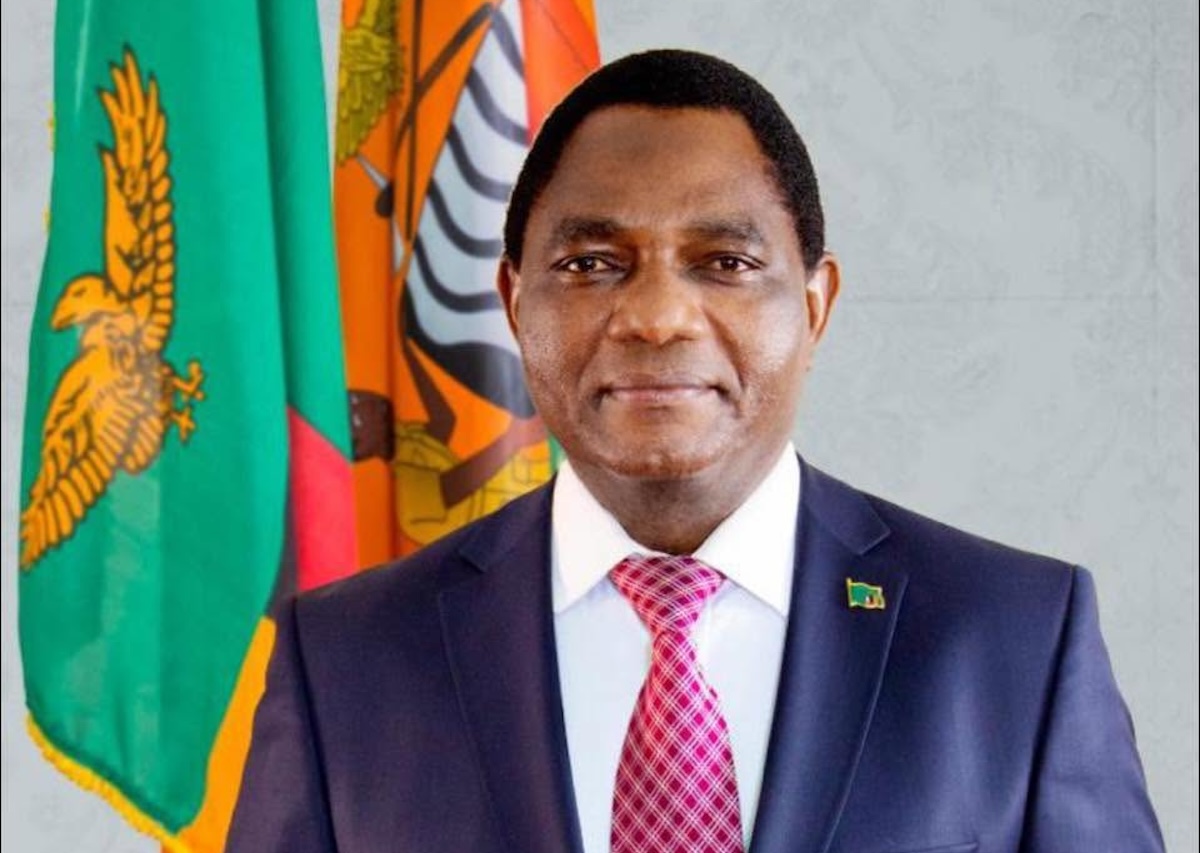
Zambian President Hakainde Hichilema. Credit: Hakainde Hichilema/Facebook official.
None of this means mining companies are saints, or that Zambia’s fiscal take is beyond debate. Reasonable Zambians disagree about royalty rates, and should. Parliament is the place for that argument, and it is happening there. What the report does is different: it recasts an open policy disagreement as evidence of institutional capture. Its underlying premise appears to leave limited room for the possibility that Zambian voters consciously endorsed precisely the policy direction now under scrutiny.
The debate therefore extends beyond mining policy alone. International organisations have every right to conduct research, publish reports and contribute to public debate. Equally, sovereign democracies have the right to ensure that electoral choices remain the preserve of their citizens. The legitimacy of a government is ultimately determined not by reports published abroad, however influential, but by the sovereign will of the people expressed through the ballot.
It is therefore legitimate to ask whether the publication of such a report, only weeks before a national election, inevitably shapes the political environment in ways that extend beyond research and into electoral discourse. Zambians are entitled to draw their own conclusions. On 13 August, the only verdict that will matter is the one delivered by the people of Zambia.
“Enforcing an elected mandate isn’t corporate capture—true democratic legitimacy belongs solely to the voters.”
There are things in the report worth keeping. Its recommendations on campaign finance transparency, lobbying registers and asset declarations are, in the main, sensible – and many are already before Zambian Parliament in the Political Parties Bill. The government would do well to embrace these reforms. Doing so would strengthen public confidence while addressing legitimate concerns about transparency and accountability. Indeed, if the report contributes to a renewed national conversation on campaign finance transparency, lobbying regulation and public accountability, then it will have served a constructive democratic purpose irrespective of one’s assessment of its central conclusions. A country confident in its choices has nothing to fear from disclosure; indeed the surest answer to insinuation is transparency so complete that insinuation has nowhere to live. Let every party publish its donors. Let every meeting between ministers and mining houses be logged. Comprehensive disclosure requirements would allow allegations of undue influence to be assessed on the basis of evidence rather than inference.
Regardless of whether one ultimately agrees with Global Witness’s conclusions, its report raises an important methodological question that extends well beyond Zambia. In democratic societies, allegations of undue influence carry considerable weight. Precisely because they do, they must be supported by evidence proportionate to the seriousness of the claims. Where that evidentiary threshold is not clearly met, scholarly and public scrutiny becomes not only appropriate but necessary. Ultimately, the legitimacy of democratic governance rests neither on advocacy reports, however well intentioned, nor on political rhetoric, but on constitutional institutions, transparent public debate and the sovereign judgment of citizens.
By Tamuka Charles Chirimambowa (PhD) and Blessing Ivan Vava (PhD)
Follow This Is Africa on Twitter and Facebook to join the conversation.


