
Arts, Culture and Sport
Literature, authorship and the human voice: Andrew Chatora’s Unstoppable March of the Human Condition
Nelson Mutongi critiques Andrew Chatora’s essay collection as a fierce defence of authentic authorship against the threat of generative AI, framing the book as an urgent interrogation of the human creative voice amid technological disruption.

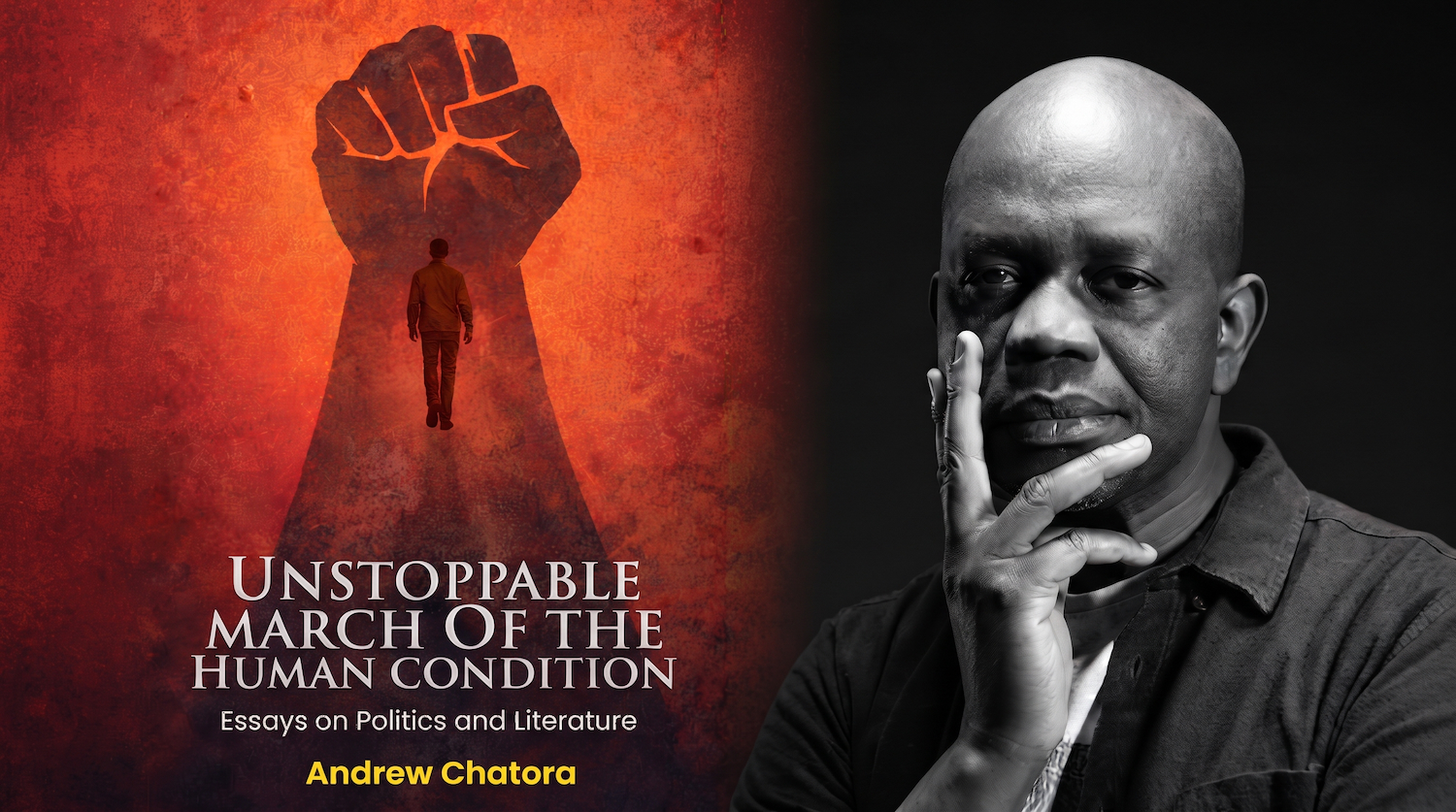
Nelson Mutongi frames Andrew Chatora’s Unstoppable March of the Human Condition as an intellectual and literary self-portrait that moves between African literary inheritance, the writer’s vocation and contemporary questions of authorship, AI and the enduring value of the human creative voice.
Andrew Chatora’s “Unstoppable March of the Human Condition: Essays on Politics and Literature,” published by Friesian Publishing in London, is a 331-page collection of essays that traverses literature, writing, literary criticism, book reviewing, and the personal experiences that shape a writer’s consciousness. The book is divided into five parts, each offering a different window into Chatora’s intellectual and literary world.
The first part is deeply personal, exploring how Chatora thinks and feels about writing and what writing means to him and does to him as a writer. The second turns towards literary appreciation, engaging with some of the major figures who have shaped African and Zimbabwean literature, including Charles Mungoshi and Stanley Nyamfukudza, among others. The third part brings together selected book reviews by Chatora, alongside reviews of his own books by Onai Mushava and other reviewers. It also includes Chatora’s “attributed and personal favourite quotes” on page 271. The fourth part is devoted to Onai Mushava’s review of Chatora’s books, while the final section presents an interview between Chatora and Lisa Carter, Director of the Canadian Wayfarer’s Intralingo Book Club, conducted in March 2023.
Like his predecessors Chinua Achebe and Ngũgĩ wa Thiong’o, among others, Chatora engages seriously with the essay as a literary and intellectual form. I concur with renowned literary critic; Memory Chirere’s observation in the foreword that these essays reveal what has “influenced the author’s own writing journey and consciousness over the years” (p. viii). That observation provides an important key to reading the collection: this is not merely a book about literature. It is, in many ways, a record of a writer thinking through his own literary journey.
Of the entire collection, I immensely enjoyed two essays, “Who Needs a Writer? There Is More to Writing Than Dollars and Cents” and “Eulogy to Greatness: Charles Lovemore Mungoshi 1947–2019”. I was particularly drawn to these two because Chatora confirmed perceptions and convictions that I have long held about writing and literature. This, however, should not be taken to mean that the other essays are inferior. Indeed, some may be superior in depth, scope and scholarly engagement. My preference here is simply a matter of intellectual and personal resonance.
“Who Needs a Writer? There Is More to Writing Than Dollars and Cents” touched me deeply because it articulates concerns that I explored in my own first collection of English poems, “Pieces of Silver.” In that collection, the poem “Whispers from the Self: A Poetic Interrogation” asks a question that every serious writer must eventually confront: Why do I write? My own conclusion was that writing is “a ritual between soul and thought.”
Chatora arrives at a remarkably similar understanding when he states that, “Writing begins as a passion.” He quotes John Grisham, whose novels I have also immensely enjoyed reading. As quoted by Chatora, Grisham states: “As I write, I don’t think about the reader, the sales, the movies. I think about the story” (p. 13).
Writing begins as a passion.
Chatora and I seem to totally concur with Grisham here. This is precisely what we do when we write. The commercial rewards, praise, recognition, awards and everything else that may follow are secondary. They are bonuses rather than the original reason for writing.
Chatora insists: “We do it for love…” (p. 16). That simple statement carries considerable weight. In an age when writing is increasingly discussed in terms of markets, sales, visibility, literary prizes and commercial success, Chatora brings the conversation back to the source: the writer’s internal compulsion to create. Before a book becomes a commodity, it is an act of imagination. Before the writer is concerned with the reader, the publisher or the market, there is the story, the poem, the idea, the disturbance within the soul that demands expression.
I found myself returning again and again to “Eulogy to Greatness: Charles Lovemore Mungoshi 1947–2019”, largely because the literary impact of Charles Mungoshi cannot be ignored. Surely, we cannot speak seriously about Zimbabwean and African literature without mentioning Mungoshi.I often wonder how one can become a Zimbabwean writer without reading Mungoshi’s works. His contribution is so deeply woven into the literary fabric of this country that encountering Zimbabwean literature without encountering Mungoshi is, in some respects, to encounter only part of the story.

Charles Mungoshi. Photo Credit: Jesesi Mungoshi via Facebook official page.
Chatora regards Mungoshi as “a deliberate moderniser of the Shona novel”, particularly through “Kunyarara Hakusi Kutaura?,” which he argues influenced Ignatius Mabasa’s style in “Mapenzi.” Chatora also acknowledges Mungoshi’s remarkable proficiency in both English and Shona. So far, I struggle to think of another Zimbabwean writer who has demonstrated quite the same level of accomplishment across the two languages.
This bilingual literary mastery is one of Mungoshi’s enduring legacies. He belonged fully to both linguistic worlds without seeming to be a stranger to either. His work demonstrates that language need not be a prison for the African writer; it can instead be a bridge between different literary and cultural imaginations.
Interestingly, Chatora mentions Garabha, whom he describes as a “nomadic character, who could come and go like wind” (p. 195). In my own collection, “Pieces of Silver,” I have a poem titled “Garabha’s Drum”. Chirere, meanwhile, wrote a full essay titled “Pursuing Garabha in Waiting for the Rain”. My interest in Garabha became so intense that I eventually befriended Farai Mungoshi, Charles Mungoshi’s son, in order to ask him whether Garabha was not perhaps one of their relatives. Why does Garabha feel so real? What is so special about him? Perhaps the answer lies in Mungoshi’s genius as a writer. Great writers create characters who transcend the pages on which they first appear. They become almost indistinguishable from the human beings among whom we live. Garabha is fictional, yet he possesses the unsettling reality of someone we might encounter wherever we happen to live. That is the magic of Mungoshi.

Chatora engages seriously with the essay as a literary and intellectual form.
Another provocative essay is “Fiction and Hallucination – Generative AI’s Genie Out of the Bottle Moment”, in which Chatora unapologetically states his position on the use of artificial intelligence in fiction writing.
“If you wanna write a book, why don’t you do it the good old way like some of us,” Chatora argues. He strongly castigates reliance on AI in fiction writing, describing its use in such circumstances as “That’s cheating” (p. 53). He adds: “That’s not true authorship” (p. 53). At another point, he describes such writers as “fraudsters… they do not deserve the title writer” (p. 59).
These are strong words, and they place Chatora firmly within one of the most important contemporary debates about authorship, originality and technology. His concern is ultimately not simply about the technology itself, but about what happens to the human creative act when the machine takes over too much of the imaginative labour.
He concludes the essay with a statement that captures his fundamental position: “Our authentic human voices and creative prowess will not be stifled or silenced” (p. 69).
Whether one entirely agrees with Chatora’s position or not, the essay is valuable precisely because it forces the writer and reader to confront questions that cannot now be avoided. What constitutes authorship in the age of generative AI? Where does assistance end and authorship begin? What happens to the writer’s individual voice when the machine becomes a participant in the creative process? These questions will increasingly define literary culture in the years ahead.
Nyashadzashe Chikumbu makes an equally important observation when reviewing Chatora’s “Inside Harare Alcatraz and Other Short Stories.” He points out that “Short stories like poetry are a lot more demanding and personal, calling for refinement in both subject matter and style” (p. 260). I concur with this observation. As an editor myself, I have noticed that writers who want to embark seriously on genres such as poetry and the short story often need rigorous workshops and sustained editorial engagement. Brevity is not necessarily simplicity. In fact, the shorter the form, the greater the demand for precision. A short story has little room for waste; every image, sentence, character and silence must carry weight. Chatora’s own literary development is significant in this regard. His growth as a writer can be traced through the critical conversations surrounding his work, and he has matured to the point where he is now referred to as an international writer.
“Unstoppable March of the Human Condition” allows us to encounter Chatora not only as a writer but also as a reader, critic, reviewer and student of literature
What makes “Unstoppable March of the Human Condition” engaging is that it allows us to encounter Chatora not only as a writer but also as a reader, critic, reviewer and student of literature. The book is consequently more than a collection of essays. It is a literary self-portrait constructed through encounters with other writers and through Chatora’s reflections on his own creative journey.

Chinua Achebe. Photo: Cliff/Flickr/Attribution 2.0 Generic (CC BY 2.0)/No changes made
The presence of Mungoshi, Achebe, Ngũgĩ and other literary figures situates Chatora within a broader African literary tradition, while his reflections on writing reveal the personal struggles and convictions behind the work. His comments on AI, meanwhile, bring the book firmly into the contemporary literary moment. There is also something valuable in the disagreements and strong positions that emerge from the collection. Literature thrives on argument. A literary essay need not simply praise; it must interrogate, provoke and sometimes unsettle. Chatora does this repeatedly.
I found these essays engaging and scholarly, and I believe the book can be read by anyone who enjoys serious literature. It should be of particular interest to literature students at A-level, university students and researchers pursuing postgraduate studies, including PhD candidates. It offers material for both appreciation and interrogation. Ultimately, “Unstoppable March of the Human Condition” is a book about writers, books and the ideas that inhabit them. But beneath all that is a more fundamental question: why do we write? For Chatora, the answer seems to return repeatedly to passion, authenticity and love. And perhaps that is where the writer’s journey begins, not with dollars and cents, not with awards or applause, but with an inner voice that refuses to remain silent.
Unstoppable March of the Human Condition is available on Amazon, online book retailers. In Zimbabwe, it is distributed via Book Fantastics in Harare contactable on: +263 77 921 0403 and Bhuku Store based in Borrowdale also contactable on: +263 77930 3621.
Nelson Mutongi is a biographer, music analyst, literary critic, book reviewer, teacher, editor and MC. He is the author of “Hwatsvira Hwemvumvira” and “Pieces of Silver,” and co-author of “Jongwe neSheche” and “Kuchema neKunakirwa” You may connect with him via email nelsonmutongi01@gmail.com |
Follow This Is Africa on Twitter and Facebook to join the conversation.


