
Africans rising
The Bitcoin that speaks USSD
How a South African engineer built the most Utu/Ubuntu thing to happen to money in a generation

Somewhere in rural Mpumalanga, a grandmother walks into a village shop. She has no smartphone. She has never heard of a blockchain. She does not know what the Lightning Network is, and she has no intention of finding out. But she has a Nokia that is older than her youngest grandchild, and in the last ten minutes she has received bitcoin from her son in Johannesburg, redeemed it for a voucher, and paid for her groceries.
This is Machankura. And it might be the most Utu/Ubuntu thing to happen to money in a generation.
Most financial technology, especially the kind that arrives with Silicon Valley packaging, begins with a hidden demand: upgrade yourself. Get a smartphone. Pay for data. Pass KYC. Learn our interface. Adapt to our system. Only then may you participate. The African who cannot meet those conditions is politely designated “unbanked,” a problem to be solved by somebody else’s product, later.
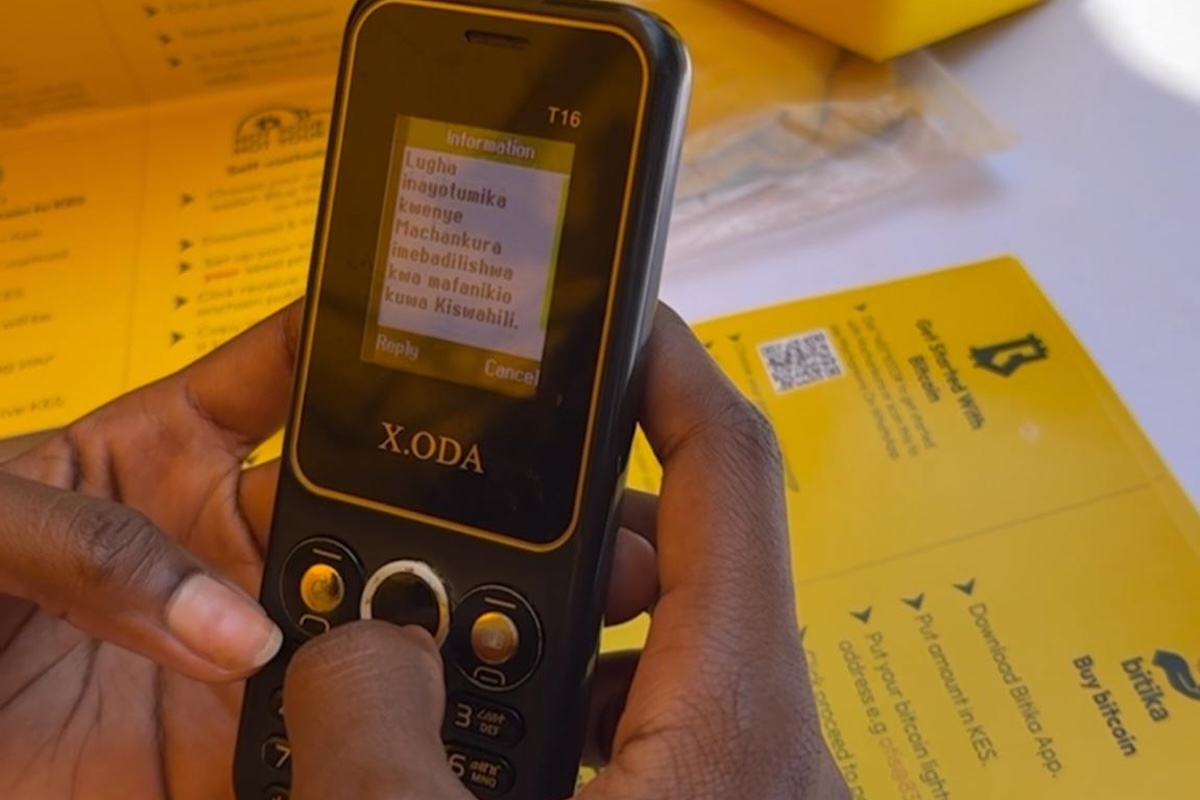
Machankura starts from the opposite instinct. Built by Kgothatso Ngako, a South African software engineer who previously worked at Amazon Web Services, the platform delivers bitcoin to any feature phone in Africa through USSD, the same unstructured, short-code menu system millions of us already use to check airtime or move M-Pesa. You dial a number. A text menu appears. You can open a wallet tied to your phone number, receive bitcoin from anywhere in the world, send it in seconds, or convert it into goods through vouchers and gift cards. No internet. No app store. No data bundle.
The scale of what this unlocks is easy to miss from a laptop. Africa had 710 million unique mobile subscribers in 2024. Only 416 million, around 28% of the continent’s population, used mobile internet. Feature phones still accounted for roughly 45% of all handset shipments into the region in 2025. For hundreds of millions of our people, an app is not a tool. It is a wall. Machankura walks around the wall.

Machankura team at the Africa Bitcoin Conference, Mauritius, 2025. Image Source: Machankura
Under the hood, the design is elegant. USSD carries the instruction; Machankura, acting as a custodian, executes the Lightning Network transaction; the recipient receives bitcoin almost instantly and for almost no fee. Ngako has added human-friendly touches like personalised Lightning addresses that read like email handles, so nobody has to type a 200-character cryptographic string on a keypad that barely has letters. The whole experience feels, intentionally, like sending mobile money. Because that is what people already know.
As of 2026, Machankura operates in at least eight countries, including Kenya, Nigeria, Ghana, Uganda, South Africa, Zambia, Namibia, and Malawi. Ngako’s stated ambition is all 54. He is not alone. Across the continent, a quiet infrastructure for bitcoin that actually works for ordinary Africans is being assembled: payment gateways in Pick n Pay stores, card rails for urban users, merchant rails for small businesses willing to accept digital assets without holding them. Machankura is the ground floor. It is the access rail that brings the entire edifice within reach of a mama mboga in Kayole, a trader in Onitsha, or a boda rider in Kampala.
The long-term goal is self-custody, where your money is truly yours and no intermediary can freeze, lose, or surrender it
None of this is utopia. Machankura is custodial, which means the service holds the keys. That is a real trade-off, and anyone serious about bitcoin should treat it as a stepping-stone, not a destination. The long-term goal is self-custody, where your money is truly yours and no intermediary can freeze, lose, or surrender it. But the point of a stepping-stone is that it exists where there was no crossing at all.
What Machankura gets right, at a philosophical level, is what too many African development initiatives get wrong. It does not ask our communities to become something else before it will meet them. It meets them in their vernacular, on their hardware, through the same text menus their mothers already trust. That is Utu expressed as architecture. *I am because we are*, and the *we* in Africa today, still, often, dials short codes.
If you live in one of the countries where Machankura runs, try it. Dial the code. Walk through the menu. Send 100 satoshis to a friend. Break the spell that the global financial system is something that happens to you. It is also, increasingly, something we can build.
Follow This Is Africa on Twitter and Facebook to join the conversation.


